Toddler won’t stay in bed? A calm plan for the “one more time” kid
One more hug, one more drink, one more question about the moon. Why toddlers keep getting out of bed, and the quiet, boring, very effective way to respond.
In this guide
The short answer
When a toddler won’t stay in bed, respond the same calm way every time: lead them back quietly, say the same few words, and leave. Make the room safe first (a gate at the door, furniture anchored), handle every need before lights out, and do not let breakouts lead to anything fun. The American Academy of Pediatrics notes that twenty “farewell appearances” in one evening is not unusual. A bedtime pass, good for one trip out per night, also has research behind it. Give it a week or two of consistency.
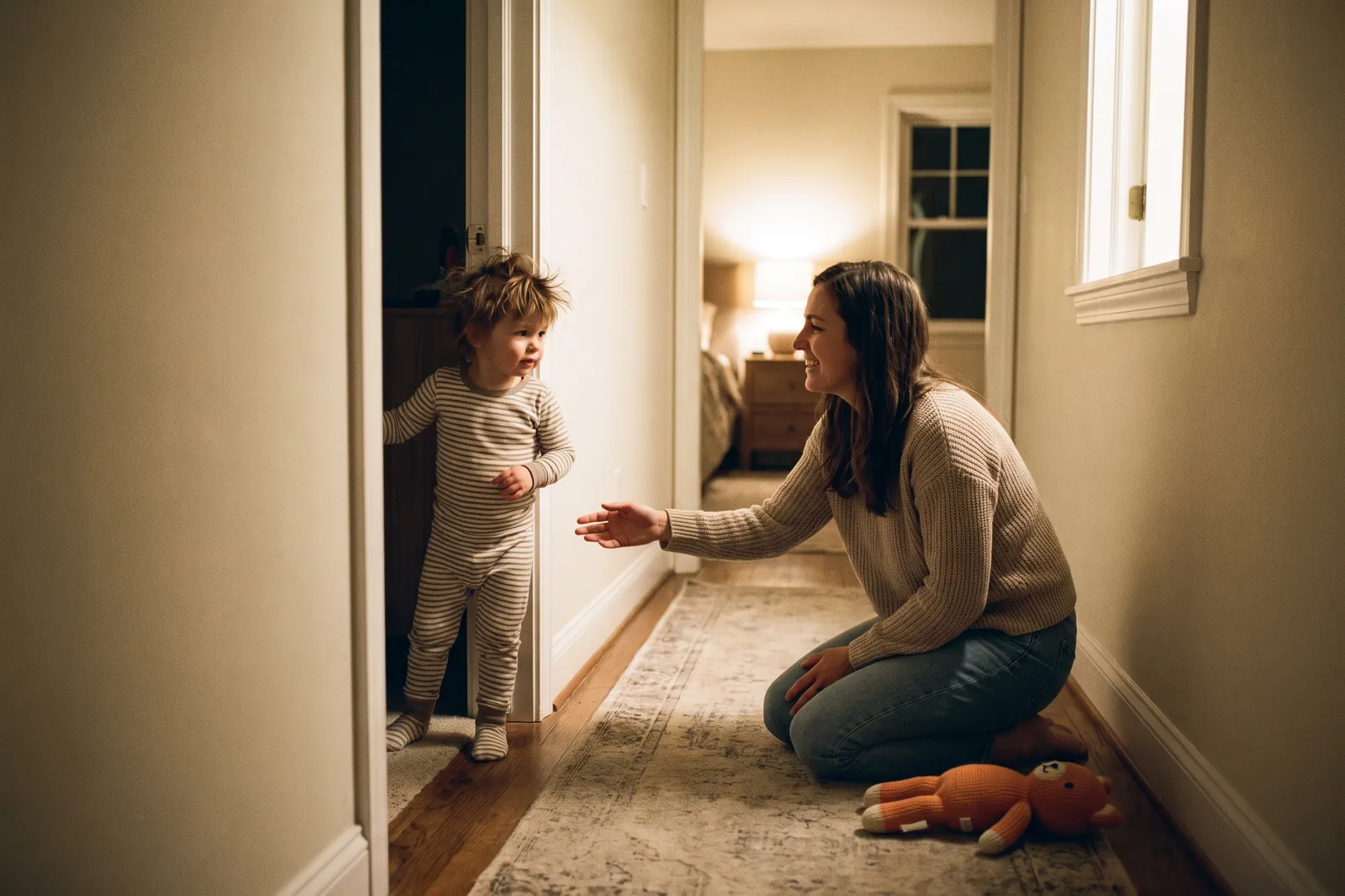
You tuck them in, say goodnight and make it as far as the hallway. Then you hear the small feet. If your toddler won’t stay in bed, you are in good company. In its advice on moving from a crib to a bed, the American Academy of Pediatrics says it plainly: twenty “farewell appearances” in one evening is by no means unusual. That sentence alone has comforted a lot of tired parents.
Here is why it happens and a calm plan to stop it, without yelling, bribes or giving up your evenings.
Why your toddler keeps getting out of bed
- New freedom. A child who just moved from a crib to a bed suddenly can get up, and the AAP notes they may feel a heady sense of freedom for the first few nights.
- Testing the limit. Toddlers check whether a rule is real by pushing on it. If getting up sometimes leads to a cuddle on the couch, it is worth trying every night.
- Connection. Some “one more time” is really “I miss you.” Ten minutes of undivided attention before the routine can help.
- Not tired, or overtired. A late nap or a late bedtime can both make lying still feel impossible.
- Fears. The dark, a noise, a shadow. Take these seriously: our guide for when a 4 year old won’t sleep alone covers fears in depth.
First, make the room safe
A toddler who can leave the bed can wander the house. Before you work on staying in bed, the AAP recommends a few safety steps:
- Install a safety gate across your toddler’s bedroom door and at the top of the stairs.
- Prevent dressers and other furniture from tipping over, and remove anything they could climb or pull down.
- If your child is still climbing out of a crib, the AAP suggests placing the crib mattress on the floor for the transition.
A gate lets you say “you stay in your room” without a closed door, so your child can still see light and hear you, and you can still hear them.
What to do when your toddler won’t stay in bed
1. Close every loophole before lights out
Last potty, last drink, the right stuffed animal, the door the way they like it. The AAP suggests taking care of needs before bedtime so they do not become reasons to get up. A short, predictable bedtime routine makes this automatic.
2. Say the rule out loud
End the routine the same way every night. The AAP’s suggestion is simple: tell your child to stay in bed until you come for them. Keep it warm and matter-of-fact: “It’s sleep time now. You stay in your bed. I’ll see you in the morning.”
3. The quiet walk back
When they appear, do not discuss, scold or negotiate. The AAP’s advice: calmly and quietly lead them back and tell them they must stay in bed. Use the same short sentence every time. Tuck them in once, no new story, no long cuddle. The AAP also suggests keeping the atmosphere quiet and even boring. If returning to bed is dull, getting up loses its point.
4. Make sure breakouts lead nowhere
The hardest part is being consistent. If getting up on the fifth try earns a spot on the couch or in your bed, your toddler learns to try five times. The AAP advises against letting children join family activities or climb into your bed when they escape, and suggests praising them for staying in bed instead.
5. Try a bedtime pass
This idea comes from pediatric research. Your child gets one card each night that can be traded for one trip out of the room or one extra visit from you: a hug, a drink, a quick question. After the pass is used, you calmly ignore further calls. In a small randomized trial of 3 to 6 year olds, published in the Journal of Pediatric Psychology, children with a pass left their rooms and called out much less, and the improvement lasted at three months. Some children love the pass so much they save it, unused, which is a win of its own.
6. Celebrate in the morning
Make a fuss over a night spent in bed: “You stayed in your bed all night! How did you do that?” Toddlers love being proud of themselves. Keep it about them rather than a prize.
7. Give it a week or two
The first nights are usually the hardest, because your toddler is checking whether the new rule is real. Every calm walk back is an answer. Give the plan a week or two before you judge it.
When a 3 year old keeps getting out of bed
At three, the getting up often comes with excellent arguments. A few things that help at this age:
- Talk about the plan in the daytime, when nobody is tired. Let them help make the bedtime pass.
- Give choices inside the rule: which pajamas, which book, which stuffed animal keeps watch. Not whether to stay in bed.
- Answer the big questions in the morning. “That’s a great question about the moon. Let’s look it up at breakfast.”
- Read a story about it. Picture books about bedtime stalling, like the ones in our list of best bedtime books for kids, let them laugh at a character doing exactly what they do.
What not to do
- No spanking or threats. The AAP advises against spanking and other harsh punishment. It increases aggression over time and does not teach the skill you want.
- No shaming. “Big kids don’t do that” tends to add worry to bedtime, which makes sleep harder.
- No locked doors. Use a gate so your child is safe and you can still hear them.
If you have lost your patience at 9 p.m. on the fifteenth trip, you are human. Apologize in the morning, start fresh that night, and be kind to yourself.
When to talk to your pediatrician
Getting out of bed is a normal toddler stage. Talk with your pediatrician if your child seems very fearful or anxious at bedtime for weeks, snores loudly or seems to stop breathing during sleep, has night terrors that keep happening, or if poor sleep is affecting their mood and behavior during the day. Asking early is always fine. For night waking specifically, see toddler waking up at night.
Questions parents ask
How do I get my toddler to stay in bed?
Handle every need before lights out, tell them to stay in bed until you come for them, and each time they get up, walk them back calmly and quietly with the same few words. Keep it boring and consistent, and do not let getting up lead to anything fun.
Is it OK to put a gate on my toddler’s door?
Yes. The American Academy of Pediatrics suggests a safety gate across a toddler’s bedroom door, and another at the top of the stairs, once they can get out of bed on their own. A gate keeps them safe while letting you both hear each other.
Why does my toddler keep coming out of their room at night?
Usually a mix of new freedom, testing whether the rule is real, wanting more time with you and not being quite tired. If getting up sometimes earns a cuddle on the couch or a spot in your bed, it becomes worth trying every night.
How long does it take for a toddler to learn to stay in bed?
Give it at least a week or two of steady consistency before you judge it. The first few nights are usually the hardest, because your child is checking whether the new rule is real.
Sources
- Big Kid Beds: When to Switch From a Crib, by Rachel Y. Moon, MD, FAAP American Academy of Pediatrics, HealthyChildren.org
- Toddler Won't Go to Sleep? 7 Tips to Help End Bedtime Battles American Academy of Pediatrics, HealthyChildren.org
- Evaluating the Bedtime Pass Program for child resistance to bedtime: a randomized, controlled trial (2007), Moore B.A. et al., Journal of Pediatric Psychology PubMed, National Library of Medicine
- The bedtime pass: an approach to bedtime crying and leaving the room (1999), Friman P.C. et al., Archives of Pediatrics & Adolescent Medicine PubMed, National Library of Medicine
- AAP Updates Corporal Punishment Policy American Academy of Pediatrics, HealthyChildren.org
- Sleep Apnea: Symptoms National Heart, Lung, and Blood Institute, National Institutes of Health
Links checked on October 12, 2026. Guidance changes; the publishers above keep the current version.
Written by the WonderLab Journal editorial desk and checked against the sources above. Found something out of date? Tell us through the corrections page.