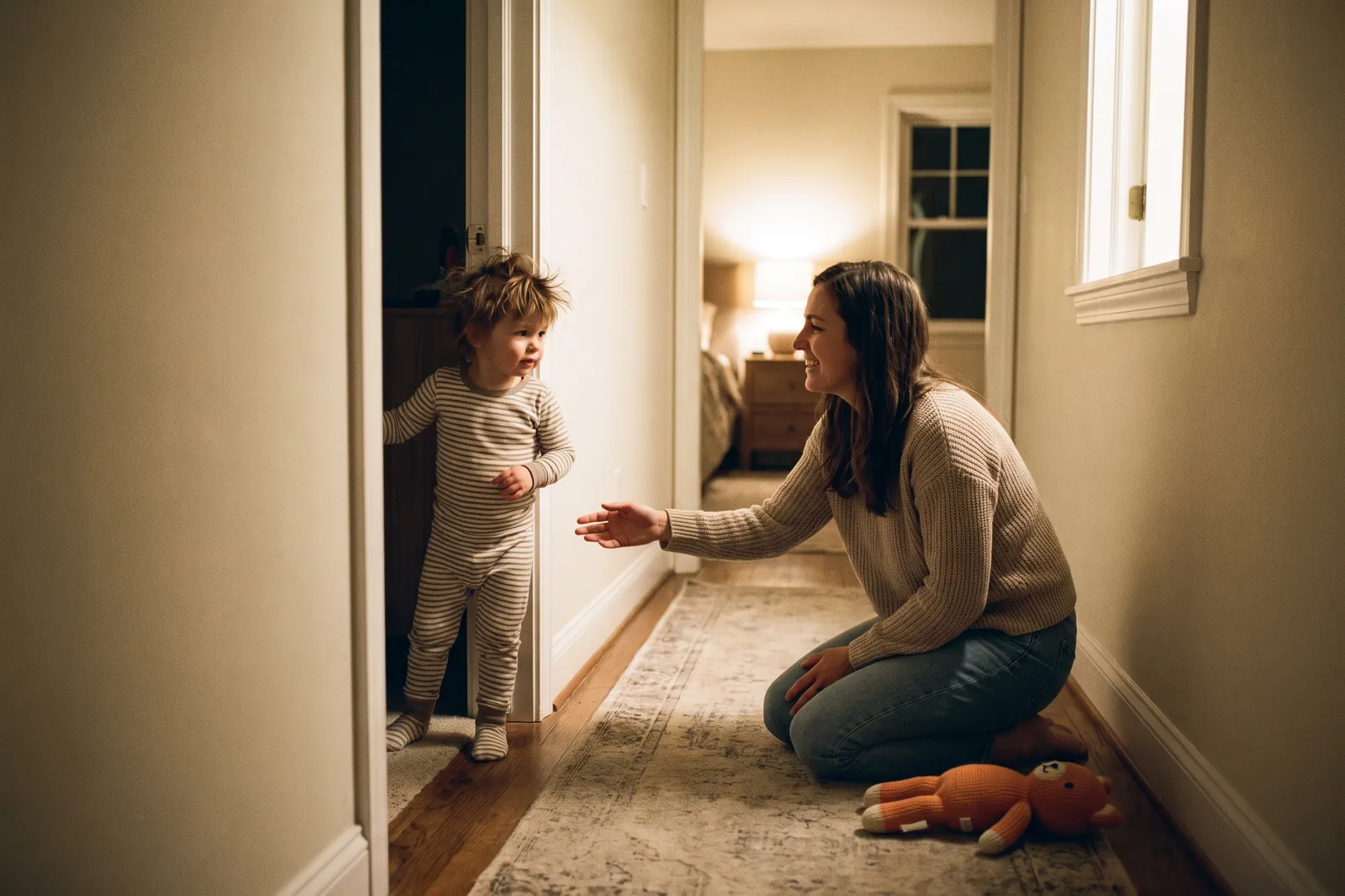
Toddler won’t sleep? What’s normal at 2 and 3, and what to try tonight
If bedtime has turned into a nightly negotiation, you are in very good company. Here is what is normal, why it happens, and a simple plan for tonight.

In this guide
The short answer
When a toddler won’t sleep, the fix is usually boring in the best way: the same bedtime every night, a short and quiet routine (brush, book, bed), needs handled before lights out, a comfort object, and brief, calm check-ins instead of long visits. Give it a week or two. The American Academy of Sleep Medicine recommends 11 to 14 hours per 24 hours (including naps) for ages 1 to 2, and 10 to 13 hours for ages 3 to 5. If your child snores loudly or seems to stop breathing in sleep, talk to your pediatrician.
It is 8:40, you have read the book three times, delivered two cups of water and answered a question about whether sharks sleep. Your toddler won’t sleep, and you are starting to wonder what you are doing wrong. Probably nothing. The American Academy of Pediatrics opens its own advice on the subject by noting that many parents find bedtime the hardest part of the day. Toddlers are discovering that they have a say in things, and bedtime is one of the few places where they can push back.
The good news is that most toddler sleep battles respond to a few steady habits. Here is what is normal, why it happens, and what to try tonight.
How much sleep do toddlers need?
Before changing anything, it helps to know the target. These are the American Academy of Sleep Medicine’s consensus recommendations, which the CDC also lists:
- Ages 1 to 2: 11 to 14 hours per 24 hours, including naps.
- Ages 3 to 5: 10 to 13 hours per 24 hours, including naps.
Notice the words “including naps.” A two year old who naps for two hours in the afternoon will need less sleep at night than one who naps for one. If your child is cheerful and well rested during the day, the total may already be fine, and the real issue is the timing.
Why your toddler won’t sleep
Most bedtime resistance at this age comes from a short list of everyday causes. Often it is two or three at once.
- They are not tired yet. A late or long nap can push bedtime past the point where your child actually feels sleepy.
- They are past tired. The AAP’s Brush, Book, Bed guidance warns against waiting for yawns and eye rubbing, since by then it is probably too late. An overtired toddler can look wired rather than sleepy.
- The house is still awake. The AAP notes that toddlers often resist sleep when older siblings are still up. Missing out is hard at two.
- They are practicing independence. Asking for one more story, one more hug and one more drink is how toddlers test where the limits are. It is a normal stage, not defiance.
- Something changed. A new bed, a new sibling, a move, a new child care arrangement or a trip can unsettle sleep for a while.
- Screens ran late. HealthyChildren.org advises turning off all screens at least an hour before bedtime to prevent sleep disruption.
What to try tonight when your toddler won’t sleep
These steps follow the AAP’s tips for toddler bedtime trouble. None of them work in one night. Together, over a week or two, they usually do.
1. Pick a bedtime and keep it
The AAP’s advice is to make bedtime the same time every night, so your child knows what to expect. Choose a time that fits the sleep ranges above, counting back from when your toddler usually wakes up.
2. Keep the routine short and the same
A quiet routine tells a small body that sleep is coming. The AAP’s version fits on a sticky note: brush teeth, read a favorite book (or two), and get to bed at a regular time. Bath, pajamas and a song can fit in too. Active, exciting play right before bed tends to work against you. Our guide to a bedtime routine for kids walks through one step by step.
3. Handle the requests before lights out
Water, potty, the right stuffed animal, the door open just so. The AAP suggests taking care of your child’s needs before bedtime so they do not become reasons to get up. Some families make it part of the routine: “Last drink, last potty, last hug.”
4. Let a comfort object come along
The AAP says it is fine at this age for a child to sleep with a teddy bear, a special blanket or a favorite toy. A familiar object can make the moment you leave the room easier.
5. Keep check-ins brief and boring
If your child calls out once you have said goodnight, and you know they are safe and well, the AAP advises against going back in each time. Many parents find a middle path easier: a short, calm visit, the same few words (“It’s sleep time. I love you. Goodnight.”), and out again. The less exciting the visit, the less reason there is to ask for another.
6. Give it time
The AAP is frank that helping a child learn good sleep habits can be a challenge, and that children need time and the chance to figure out how to settle themselves. Expect a bumpy few nights before things improve. If your toddler keeps climbing out of bed, our plan for the toddler who won’t stay in bed covers that specific battle.
My 3 year old won’t sleep at night: what is different at three
Three year olds bring a few new twists. Their imagination is taking off, so the dark can suddenly hold monsters. Their language is good enough to negotiate in full sentences. And for many, the afternoon nap is getting shorter or harder to fit in.
- If the nap is late, bedtime may simply come before your child is tired. Try moving the nap earlier, or swapping it for quiet rest on some days, and watch whether bedtime gets easier over a week.
- If fears appear, take them seriously without making them bigger. A night light and a calm “You are safe, we are right here” go a long way. Our guide for when a 4 or 5 year old won’t sleep alone covers fears in more depth.
- If they negotiate, offer choices inside the routine rather than about it: this book or that one, the blue pajamas or the striped ones.
Toddler won’t sleep through the night
Falling asleep and staying asleep are different problems. A toddler who wakes at 2 a.m. may be having a nightmare, may be partly awake during a night terror, or may have woken briefly and not known how to settle again. Nightmares can start in the first year and are most common between ages 3 and 12, according to HealthyChildren.org. We cover the common causes, and what to do for each, in toddler waking up at night.
A word on melatonin
Melatonin gummies are easy to find, so it is natural to wonder. The AAP is clear: melatonin is not a sleeping pill, it should only be used after a discussion with your pediatrician, and it should not be a substitute for a good bedtime routine. Start with the routine.
When to talk to your pediatrician
Most toddler sleep struggles are a phase that steady habits can fix. Check in with your pediatrician if:
- your child snores loudly most nights, or you notice breathing that starts and stops. The National Heart, Lung, and Blood Institute lists these among the signs of sleep apnea in children;
- night terrors keep happening;
- poor sleep seems to be affecting their mood, behavior or energy during the day;
- you are simply worried, or exhausted. Asking is never an overreaction.
And be kind to yourself in the meantime. A toddler who fights sleep is not a sign that you have done anything wrong. It is a sign that you have a toddler.
Questions parents ask
How much sleep does a 3 year old need?
The American Academy of Sleep Medicine recommends that children 3 to 5 years old sleep 10 to 13 hours per 24 hours, including naps. For ages 1 to 2, the range is 11 to 14 hours, including naps. A child who is rested and cheerful during the day is usually getting enough.
Why does my toddler fight sleep even when tired?
Overtired toddlers can look wired rather than sleepy, and many are also testing limits or do not want to miss what the rest of the family is doing. A consistent bedtime that starts before the yawning, plus a short, predictable routine, usually helps more than a later bedtime.
Should I stay in the room until my toddler falls asleep?
It is a family choice, and many parents do it for a season. If you want your child to fall asleep on their own, the AAP recommends making sure they are safe and well, then keeping your return visits to a minimum. Brief, calm, boring check-ins are a gentle middle step.
Can I give my toddler melatonin to help them sleep?
Only after talking with your pediatrician. The American Academy of Pediatrics says melatonin is not a sleeping pill and should not replace a good bedtime routine, which solves most toddler sleep troubles on its own.
Sources
- Recommended Amount of Sleep for Pediatric Populations: A Consensus Statement of the American Academy of Sleep Medicine (2016), Paruthi S. et al., Journal of Clinical Sleep Medicine American Academy of Sleep Medicine, via PubMed Central (National Library of Medicine)
- About Sleep: how much sleep do I need? Centers for Disease Control and Prevention
- Healthy Sleep Habits: How Many Hours Does Your Child Need? American Academy of Pediatrics, HealthyChildren.org
- Toddler Won't Go to Sleep? 7 Tips to Help End Bedtime Battles American Academy of Pediatrics, HealthyChildren.org
- Brush, Book, Bed: How to Structure Your Child's Nighttime Routine American Academy of Pediatrics, HealthyChildren.org
- Melatonin for Kids: What Parents Should Know About This Sleep Aid American Academy of Pediatrics, HealthyChildren.org
- Nightmares and Night Terrors in Preschoolers American Academy of Pediatrics, HealthyChildren.org
- Sleep Apnea: Symptoms National Heart, Lung, and Blood Institute, National Institutes of Health
Links checked on October 12, 2026. Guidance changes; the publishers above keep the current version.
Written by the WonderLab Journal editorial desk and checked against the sources above. Found something out of date? Tell us through the corrections page.