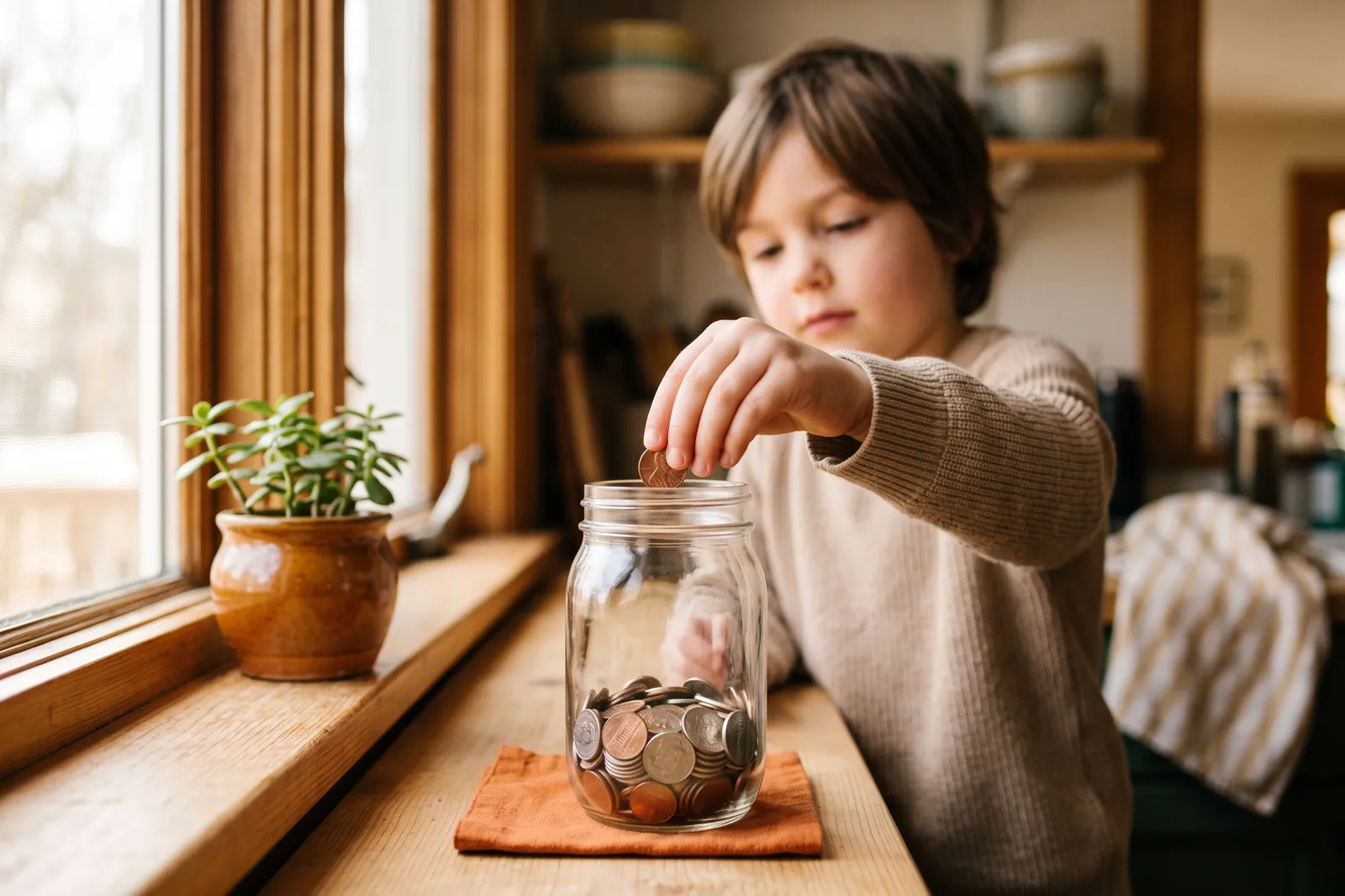
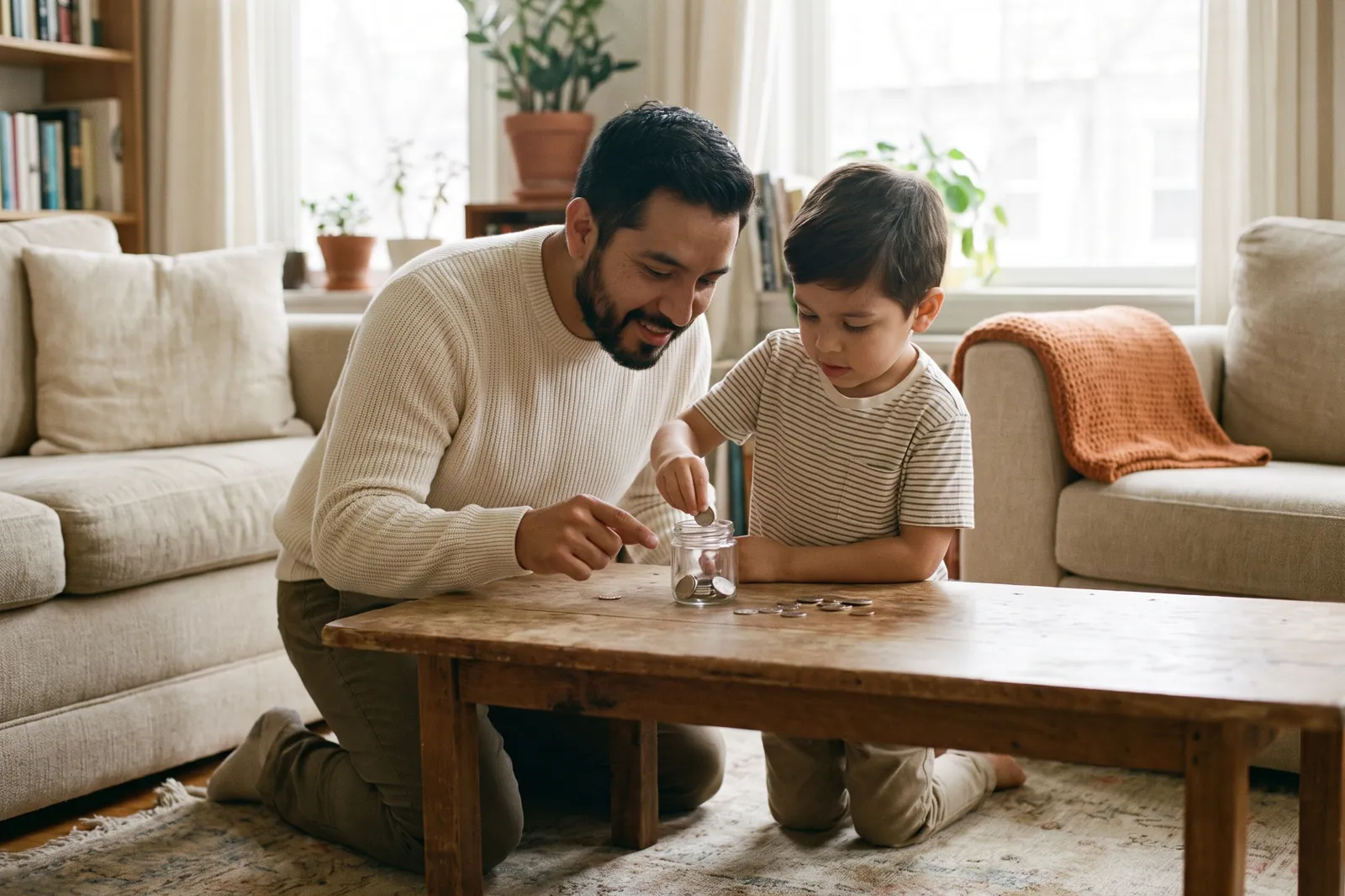
Save, spend, share jars: how the three-jar system works for young kids
Three clear jars, one simple rule: every time money comes in, it gets split. How to set them up, how to divide the coins, and what to do when the spend jar is always empty.
In this guide
The short answer
Save spend share jars are three labeled containers, usually clear, that a child splits their money into whenever they get some. Spend is for small things now, save is for a goal later, and share is for giving. There is no official split: equal thirds is easy to remember, and the CFPB suggests older kids save at least a dime of every dollar. The jars work with any money a child receives, not only an allowance.
Save spend share jars are one of the simplest money tools you can give a young child. Three jars sit side by side on a shelf, and every time money comes in, from a birthday card, a grandparent or a small job, your child decides how much goes into each. It turns three big ideas, spending, saving and giving, into something they can see and touch.
The idea is popular with families and teachers alike, and it is easy to start this weekend with three jars from your kitchen.
What are save spend share jars?
- Spend: money your child can use soon, on small things they choose.
- Save: money set aside for one specific goal that costs more than they have today.
- Share: money for giving, to a cause, a person or a community they care about.
Why it works at this age comes down to visibility. A 2013 review for the UK’s Money Advice Service, by University of Cambridge researchers David Whitebread and Sue Bingham, found that young children learn money habits from what parents model, discuss and demonstrate, and it names sharing, saving and purchasing as basic skills parents can show at home. The jars put all three on the shelf where your child can see them every day.
How to set up the three-jar system
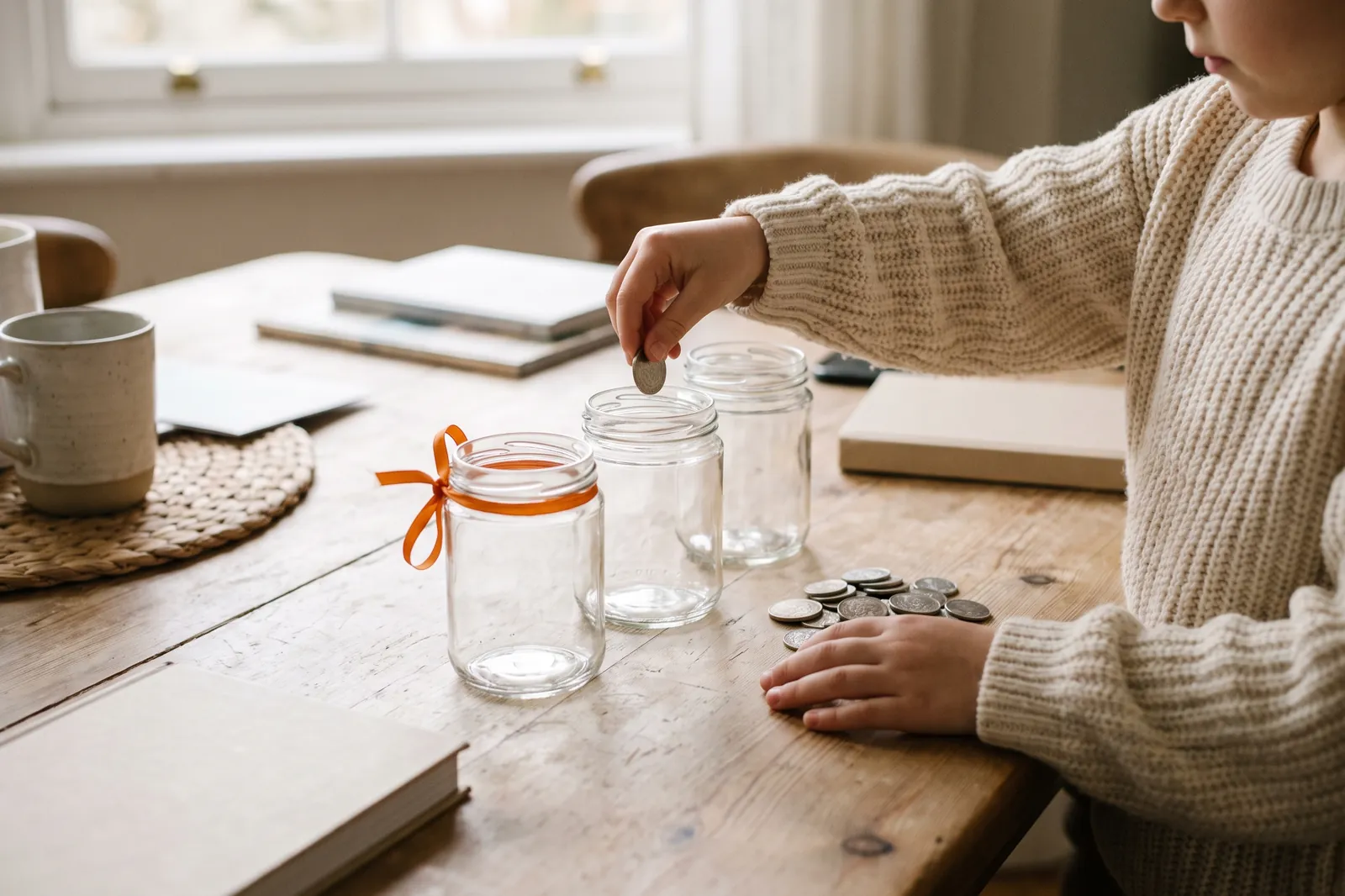
- Pick three clear containers. Glass jars, plastic food tubs with a slot cut in the lid, anything see-through. The CFPB’s suggestion for ages 3 to 5 is just as simple: find a jar or can and label it.
- Label them together. Write SPEND, SAVE and SHARE. For children who are not reading yet, add a picture to each: a shopping bag, the goal they are saving for, and a heart or a helping hand.
- Pick a save goal. Tape a photo or drawing of the goal to the save jar. Saving for “later” is too vague at this age; saving for the red kite is not.
- Choose a share cause. Let your child help decide: an animal shelter, a food bank, a friend’s fundraiser, a gift for a grandparent.
- Agree on the split. Keep the rule short enough for your child to say back to you.
Save spend share percentages: how to split the money
There is no research-backed “right” split, so pick a rule your child can follow and adjust it as they grow. A few that families commonly use:
| Split | How it works | Good for |
|---|---|---|
| Equal thirds | One coin in each jar, round and round, until the money is gone | Ages 3 to 5. No math needed |
| Half, then the rest | Half to save, the rest split between spend and share | A child saving for something bigger |
| At least a dime per dollar | At least 10 cents of each dollar goes to save, and the child decides the rest | Ages 6 to 8, who can count change |
The last rule comes straight from the CFPB’s guidance for ages 6 to 12: “It’s a good habit to save at least a dime for every dollar you receive.” For younger children, the coin-by-coin round is the easiest, because the fairness is visible. If the money comes as a bill, swap it for coins first, so splitting is something your child does with their own hands. Counting the coins together is good practice too; see how to teach kids to count money.
Where the money comes from
The jars are not an allowance system, and they do not need one. Birthday money, the tooth fairy, coins found in the couch, a gift from a grandparent or a few dollars for helping a neighbor all go through the same three jars. Some families do pair the jars with a regular allowance; if you are considering one, see allowance for kids by age and ways for kids to earn money.
Making each jar work
The spend jar: let it be theirs
Spend money only teaches if your child really gets to spend it. Let them choose, even if they choose badly. A few dollars on something that breaks by Tuesday is a cheap lesson in value. Our guide on how to teach kids the value of money has ideas for those store trips.
The save jar: keep the goal close
A goal that takes months will wear out a five-year-old. Aim for one they can reach in a week or two at first, and celebrate when they get there. A coloring chart next to the jar, one circle per coin or dollar, makes progress easy to see. For step-by-step ideas, read how to teach kids to save money.
The share jar: let them see where it goes
Giving is more meaningful when a child can picture who it helps. Let them drop the money in the donation box, hand over the gift or see the photo of the shelter animals. There is some lovely research behind this, too. In a 2012 study in PLOS ONE, Lara Aknin, Kiley Hamlin and Elizabeth Dunn found that toddlers just under two looked happier giving treats to someone else than receiving treats themselves, and happier still when they gave away treats of their own rather than extra ones. It was a small study of 20 toddlers, so treat it as a hint, not a rule, but it suggests giving can feel good very early.
Common questions families run into
- “The spend jar is always empty.” That is normal at first. It is also information. Talk about it: “You spent it all on Saturday. How do you feel about that now?”
- “They want to move money between jars.” Decide on a family rule and stick to it. Many families let money move from spend to save or share, but not out of save before the goal.
- “Only three jars?” For ages 3 to 4, two jars (spend and save) may be plenty. Add the share jar once the first two make sense.
- “They lost interest.” Refresh the save goal. A new picture on the jar often brings back the energy.
Picture books that pair well with the jars
Tía Isa Wants a Car, by Meg Medina, illustrated by Claudio Muñoz
Ages 3 to 7. Tía Isa is saving for a car to take the whole family to the beach, while her niece does odd jobs for neighbors to help. Saving is slow, because half of the money is set aside to someday bring family members who live far away to join them. It is a natural lead-in to a talk about saving and sharing side by side.
Sam and the Lucky Money, by Karen Chinn, illustrated by Cornelius Van Wright and Ying-Hwa Hu
Ages 5 to 8. On Chinese New Year, Sam gets red envelopes of lucky money and, for the first time, can spend it any way he chooses. When he finds it is not enough for the things he wants, he is disappointed, until a surprise encounter with a stranger changes how he sees his gift. A thoughtful book for the share jar.
Questions parents ask
What are save spend share jars?
They are three labeled containers, usually clear, that a child divides their money into whenever they receive some. Spend is for small purchases soon, save is for a specific goal, and share is for giving. Seeing all three side by side makes the choices concrete.
What percentage should go in each jar?
There is no single right answer. Equal thirds is easy for young children, done coin by coin. For ages 6 and up, the CFPB suggests saving at least a dime of every dollar, which leaves room for the child to decide the rest.
What age is right for a three-jar system?
Many children can start with two jars, spend and save, around age 3 or 4, and add a share jar once they understand the first two. By 6 to 8, most can handle a simple percentage rule and count their own coins.
Do you need an allowance for the jars to work?
No. Any money a child receives can go through the jars: birthday money, gifts from relatives, the tooth fairy or a few dollars for helping out. An allowance is optional.
Sources
- Young children and saving Consumer Financial Protection Bureau
- School-age children and saving Consumer Financial Protection Bureau
- Habit Formation and Learning in Young Children (May 2013), David Whitebread and Sue Bingham, University of Cambridge Money Advice Service, now the Money and Pensions Service
- Giving Leads to Happiness in Young Children (2012), Lara B. Aknin, J. Kiley Hamlin and Elizabeth W. Dunn PLOS ONE
- Tía Isa Wants a Car, by Meg Medina Candlewick Press
- Sam and the Lucky Money, by Karen Chinn Lee & Low Books
Links checked on October 12, 2026. Guidance changes; the publishers above keep the current version.
Written by the WonderLab Journal editorial desk and checked against the sources above. Found something out of date? Tell us through the corrections page.