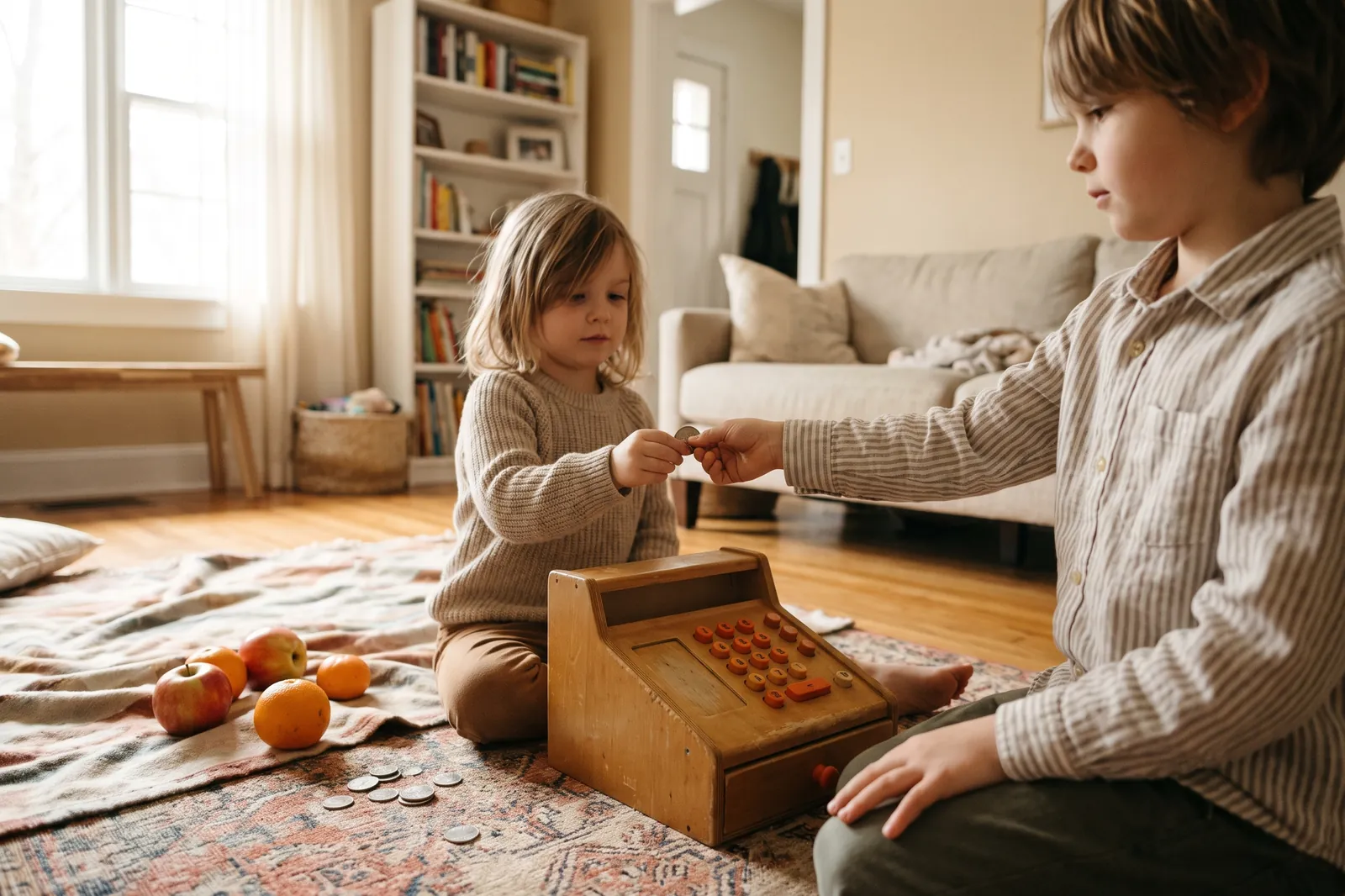
How to teach kids to count money: coins first, then the dollar
A parent’s step-by-step path from a pile of loose change to counting a dollar and making change, with the coin facts straight from the U.S. Mint.
Go in this order: sort coins by kind, learn each coin’s name and value, skip count one kind at a time (by 5s, 10s, 25s), then count mixed coins starting with the biggest value. Next, make a dollar in different ways, meet the bills, and finally practice change. Use real coins and short sessions. Counting coins and dollar bills is a second grade math standard in the Common Core, so most children get there around age 7 or 8.
If you are wondering how to teach kids to count money, the good news is that you already own the best teaching kit: the change at the bottom of your bag. Counting money is a math skill first. Knowing what that money is worth in real life is a separate skill, covered in our guide on how to teach kids the value of money. This guide is the math side, step by step.
What age should a child know how to count money?
Counting coins and bills is part of second grade in the Common Core math standards, which many states use: “Solve word problems involving dollar bills, quarters, dimes, nickels, and pennies, using $ and ¢ symbols appropriately.” That puts mastery around age 7 or 8.
The groundwork starts earlier. A 2013 review for the UK’s Money Advice Service, by Cambridge researchers David Whitebread and Sue Bingham, explains that very young children judge coins by size and number: offered five small coins or one coin worth the same, they will probably pick the five because it looks like more. Typically by about age seven, children can hold the idea of value in their heads. So at four and five, play with coins. At six and seven, count them.
How to teach kids to count money, step by step
Seven steps, in order. Move on when one feels easy, and go back a step whenever it doesn’t. A few minutes a day is plenty.
Step 1: Sort before you count (ages 4 to 5)
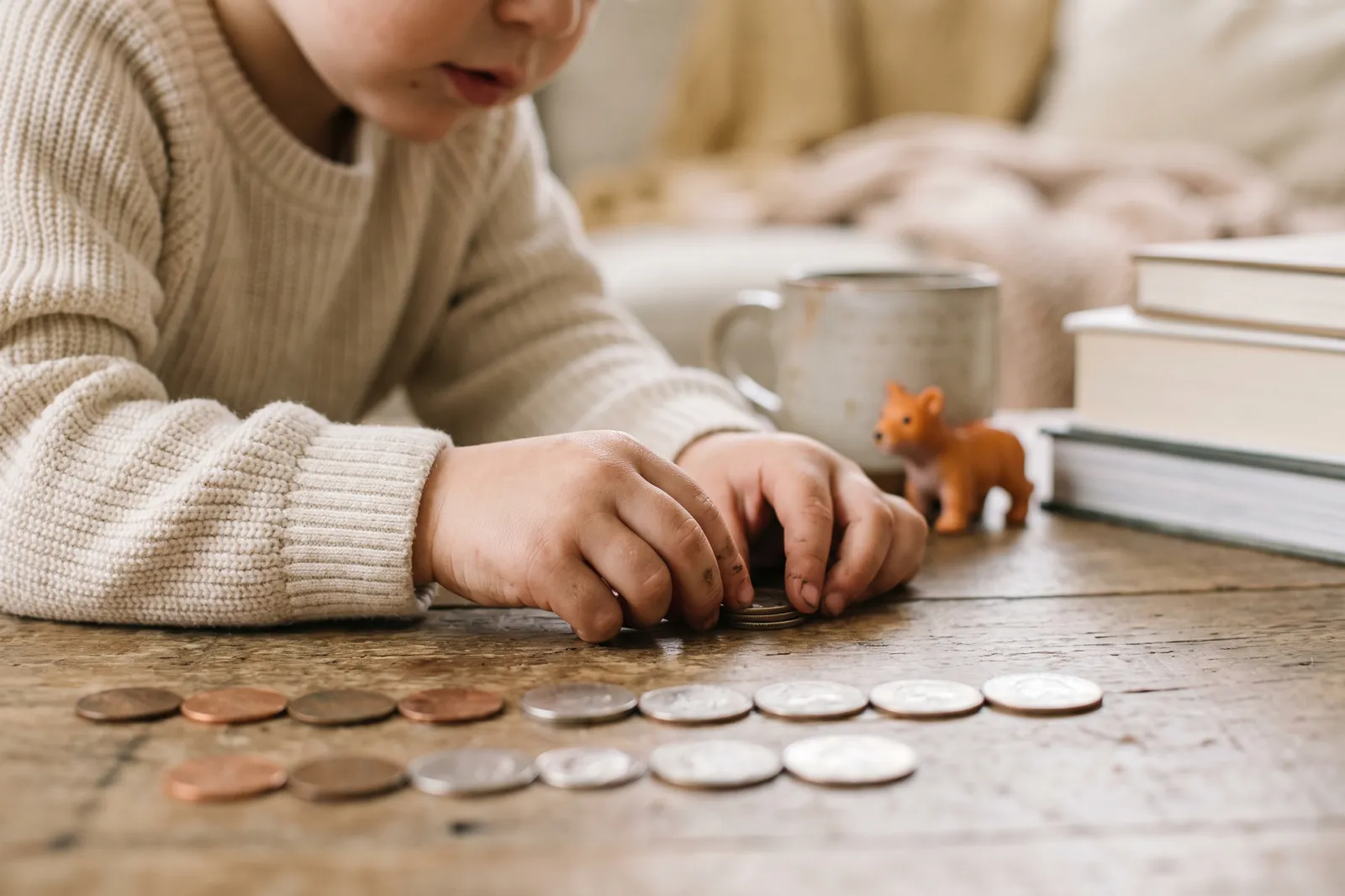
Put a handful of mixed coins on a tray and sort them into piles. No numbers yet. Your child is learning to look closely: color, size, the edge, the pictures. Use real coins and stay close, since coins are small enough to be a choking hazard for young children.
Step 2: How to teach kids about coins, one at a time
Introduce each coin with its name, its value and one thing that makes it easy to spot. These facts come from the U.S. Mint.
| Coin | Worth | How to spot it |
|---|---|---|
| Penny | 1 cent | Copper color, smooth edge, President Lincoln |
| Nickel | 5 cents | Silver color, smooth edge, thicker than a penny, President Jefferson |
| Dime | 10 cents | The smallest coin, with a ridged edge |
| Quarter | 25 cents | The biggest everyday coin, with a ridged edge |
How to help kids identify coins:
- Feel the edge. The Mint’s specifications list the penny and nickel with a plain edge, and the dime and quarter with a reeded, or ridged, one. Kids can tell them apart with their eyes closed.
- Name the tricky one out loud. The dime is the smallest coin but worth more than a penny or a nickel. Say it often, because it goes against everything a young child expects.
- Teach size and edge before pictures. Designs change. For 2026 only, the dime shows Lady Liberty instead of President Franklin D. Roosevelt, who returns in 2027, and the quarter has several special designs. Size and edge stay the same.
A note on pennies: the U.S. Mint struck its last penny for circulation in November 2025. Pennies remain legal tender and there are still billions in circulation, so they will keep turning up in change, and they are still the easiest coin for counting by ones.
Step 3: Skip count one kind at a time (ages 5 to 7)
Before mixing coins, count piles of a single kind:
- Pennies by ones: 1, 2, 3, 4.
- Nickels by fives: 5, 10, 15, 20.
- Dimes by tens: 10, 20, 30, 40.
- Quarters by twenty-fives: 25, 50, 75, one dollar.
Tap each coin as you say the number. Counting by 5s and 10s is useful math well beyond money, so this step pays off twice.
Step 4: Count mixed coins, biggest first (ages 6 to 8)
Now the real skill. Teach one simple rule: line coins up from the biggest value to the smallest, then count on.
Example with 1 quarter, 2 dimes, 1 nickel and 3 pennies: start at 25, then 35, 45, then 50, then 51, 52, 53. That is 53 cents. Write it two ways, 53¢ and $0.53, so both symbols become familiar.
If your child gets lost, go back to fewer coins. Two kinds at a time, like dimes and pennies, is a fine place to stay for a few weeks.
Step 5: Make a dollar
A dollar is 100 cents, which can look like 100 pennies, 20 nickels, 10 dimes or 4 quarters. Build each one on the table and compare the piles. Then try mixes: three quarters, two dimes and a nickel also make a dollar. This step quietly answers the Cambridge puzzle, because a big pile of pennies and a small stack of quarters are worth exactly the same.
Step 6: Meet the bills
Bills are easier than coins in one way: the number is printed on them. Start with the $1, $5, $10 and $20. Each carries a portrait, according to the U.S. Currency Education Program: George Washington on the $1, Abraham Lincoln on the $5, Alexander Hamilton on the $10 and Andrew Jackson on the $20. Count a mix of small bills, then add coins: one dollar bill and three quarters is $1.75.
Step 7: Practice change (around age 7 and up)
The Cambridge review notes that children usually begin to understand why a cashier hands back change as they approach seven. Practice at home first. In a pretend store, an item costs 60 cents and your child pays with a dollar. Count up from 60 with coins: a dime makes 70, three more dimes make a dollar. That is 40 cents in change. Then let them watch it happen at a real register.
Free resources from the U.S. Mint
The U.S. Mint’s Coin Classroom site has free games, activities and lesson plans for kids, including a counting game and a making change game. Playing one together and talking through each answer turns screen time into a shared practice session. For hands-on ideas, see our list of money activities for kids.
Two books that count along
The Coin Counting Book, by Rozanne Lanczak Williams. Illustrated with real money, it covers counting, adding and identifying U.S. coins from one penny up to one dollar, in simple rhyming text. The publisher lists it for ages 6 to 9.
26 Letters and 99 Cents, by Tana Hoban. A wordless classic that is two books in one, an alphabet book and a counting book, told in color photographs of letters, numbers and coins. Lay out your own coins and match the pictures. The publisher lists it for ages 4 to 8, which makes it the easier of the two to start with.
Questions parents ask
What age should a child know how to count money?
Most children master counting coins and bills around age 7 or 8. In the Common Core math standards, solving problems with dollar bills, quarters, dimes, nickels and pennies is a second grade skill. Sorting and naming coins can start at 4 or 5.
Which coin should kids learn first?
The penny, because it is worth one and counts like ordinary numbers. Then the nickel and dime, which match counting by 5s and 10s, and the quarter last. The dime needs extra attention because it is the smallest coin but worth more than a penny or a nickel.
How do I help my child tell a dime from a penny?
Color and edge. The penny is copper colored with a smooth edge, while the dime is silver colored and has a ridged edge, according to the U.S. Mint. The dime is also the smallest U.S. coin. Let your child feel both with eyes closed.
Are pennies still used?
Yes. The U.S. Mint struck its last penny for circulation in November 2025, but pennies remain legal tender and billions are still in circulation, so children will keep seeing them in change.
Sources
- Grade 2, Measurement and Data, standard 2.MD.C.8
- Coin Specifications
- Circulating Coins
- United States Mint Hosts Historic Ceremonial Strike for Final Production of the Circulating One-Cent Coin (November 12, 2025)
- U.S. currency denominations
- U.S. Mint Coin Classroom: games, activities and lesson plans
- Habit Formation and Learning in Young Children (May 2013), David Whitebread and Sue Bingham, University of Cambridge
- The Coin Counting Book, by Rozanne Lanczak Williams
- 26 Letters and 99 Cents, by Tana Hoban
Written by the WonderLab Journal editorial desk and checked against the sources above. Found something out of date? Tell us through the corrections page.