My kid thinks I’m an ATM: what to say when money seems unlimited
If your child thinks the card always works and the machine always pays, they are not spoiled. They are reasoning from what they can see. Here is how to show them the rest.

Young children see money come out of a machine or a card, but they rarely see it go in. So “we have unlimited money” is a logical guess, not a character flaw. Show the whole loop: work, pay, bank, card, store. Use cash now and then so they can watch a trade happen, talk calmly about choices instead of scarcity, and give them a small amount of their own to manage.
“Just get more from the machine.” “Use the card, it always works.” If you have ever said, half laughing and half tired, my kids think I’m an ATM, you are far from alone. Plenty of parents hear some version of “she thinks we have unlimited money” from their own mouths sooner or later.
Here is the reassuring part: it is not a sign that you have raised a spoiled child. It is a sign that your child is a good observer. They have watched money appear when you tap a card or press a few buttons, and they have drawn the obvious conclusion. Your job is not to scold the conclusion. It is to show them the part of the picture they cannot see yet.
Why kids think money is unlimited
Think about what a five-year-old actually sees. A card goes into a machine and bills come out. A phone touches a screen and the groceries are paid for. What they almost never see is the other half: the hours of work, the paycheck, the bank balance going down.
The way families pay has shifted, too. The Federal Reserve’s annual Diary of Consumer Payment Choice found that in 2016 cash made up roughly one third of all consumer payments. In 2025 it was 14 percent, about six payments a month, with debit and credit cards ahead of it. That is not a problem to fix. It simply means money is less visible to children than it was a generation ago, so it helps to make it visible on purpose.
Development plays a part as well. A 2013 review for the UK’s Money Advice Service, by University of Cambridge researchers David Whitebread and Sue Bingham, notes that cards and checks are not themselves money but stand for it, which takes an extra step of understanding. The same review suggests it is probably not until after age seven that children begin to grasp that every exchange involves a chain of unseen transactions among other people. Before then, the card really does look like magic.
“My kids think I’m an ATM”: what to say instead
You do not need a speech. Short, calm, true sentences, repeated over months, do the work. Pick the ones that sound like you.
When they say “Just use the card”
- “The card isn’t money. It’s a key to our money in the bank.”
- “The card only works because we put money in first.”
- “Every time I tap it, that money is gone from our account.”
When they say “Get more from the machine”
- “The machine gives us our own money back. It can’t make new money.”
- “If we take it out today, it isn’t there for groceries later.”
When they ask “Why can’t we just buy it?”
- “We have enough for what we need, and we choose what else to spend on.”
- “Not today. We’re using our money for the beach trip.”
- “Let’s put it on your wish list and look again next week.”
Notice what these sentences avoid. There is no “we’re broke” and no “money doesn’t grow on trees.” Young children can absorb adult worry without the context to understand it. Framing money as a series of choices keeps it honest and keeps it calm.
Show the whole money loop
Most of what children are missing is the beginning of the story. Walk them through it, ideally with a drawing on the back of an envelope:
- Work. “I go to work, and I get paid for the work I do.”
- Pay. “My pay goes into the bank, where it stays safe.”
- Bank. “The bank keeps track of how much is ours.”
- Card or machine. “The card and the machine let us use what is ours.”
- Store. “When we buy something, the money goes to the store, and our pile gets smaller.”
The Consumer Financial Protection Bureau’s Money as You Grow guidance puts the first idea for ages 3 to 5 very simply: “You need money to buy things, and you earn money by working.” Talk about what different grown-ups do all day, and how they get paid for it. You do not need to share your salary. The point is the order of events: the money comes first from work, then it can be spent.
For older kids, the CFPB suggests something even more concrete for ages 6 to 12: visit a bank or credit union together, or show them your online banking site. Seeing a balance go down after a purchase can do more than any explanation.
Make money visible again, sometimes
You do not have to switch to cash. Cards are a normal part of life, and your child will use them one day. A little visible money, now and then, is enough.
- Let them pay for one small thing with cash. They hand it over, they get change back, the money is gone. The Cambridge review suggests exactly this kind of purchase to show that money can be spent only once.
- Narrate a card payment. “This costs twelve dollars. When I tap, twelve dollars leaves our bank.”
- Think out loud about your choices. The CFPB suggests asking yourself aloud at the store: Do I need this item? Can I borrow it? Would it cost less somewhere else?
- Point out free fun. The CFPB also suggests talking about things your child enjoys that are free, like playing with a friend or going to the library.
Give them a small amount that is theirs
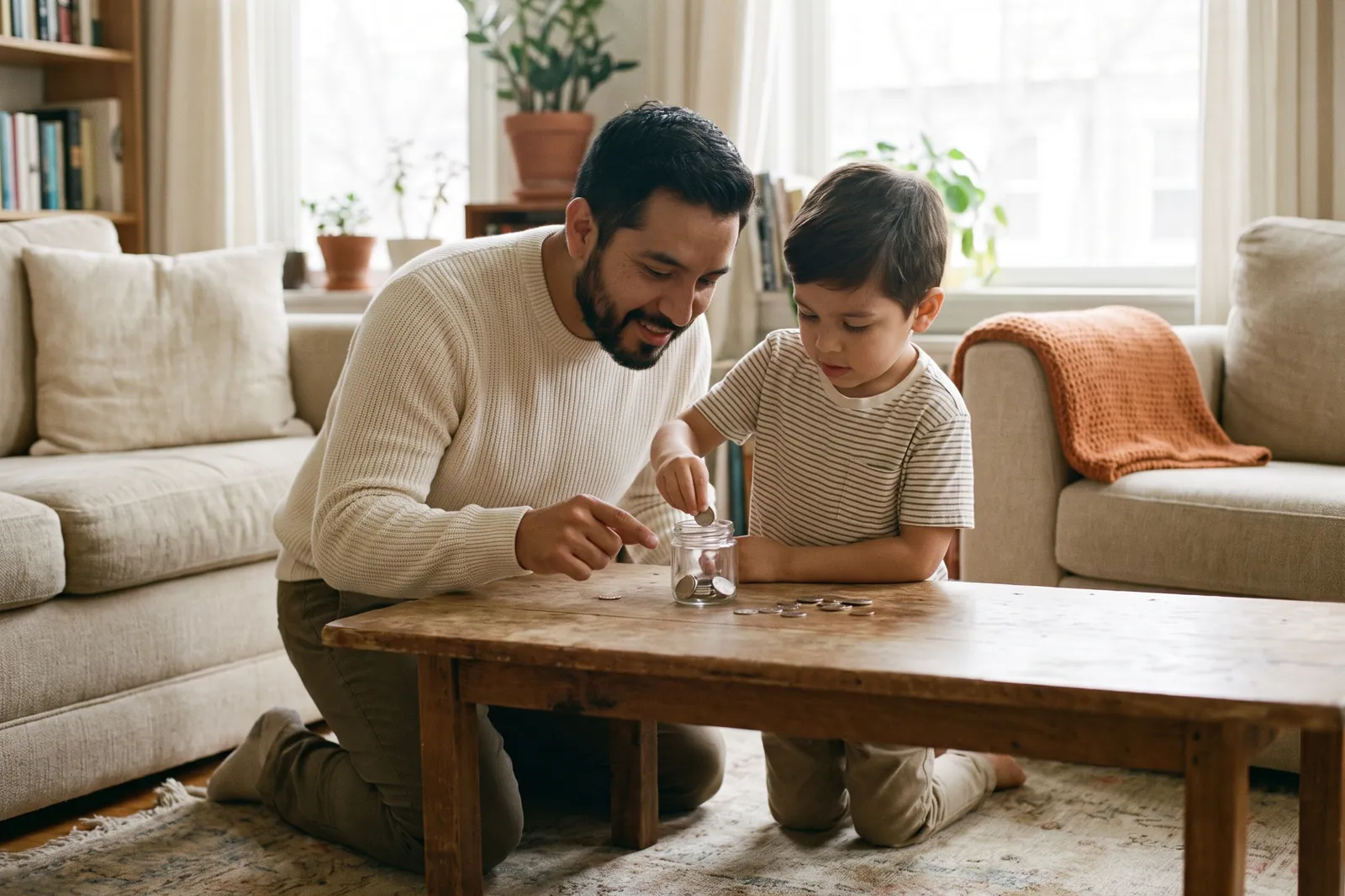
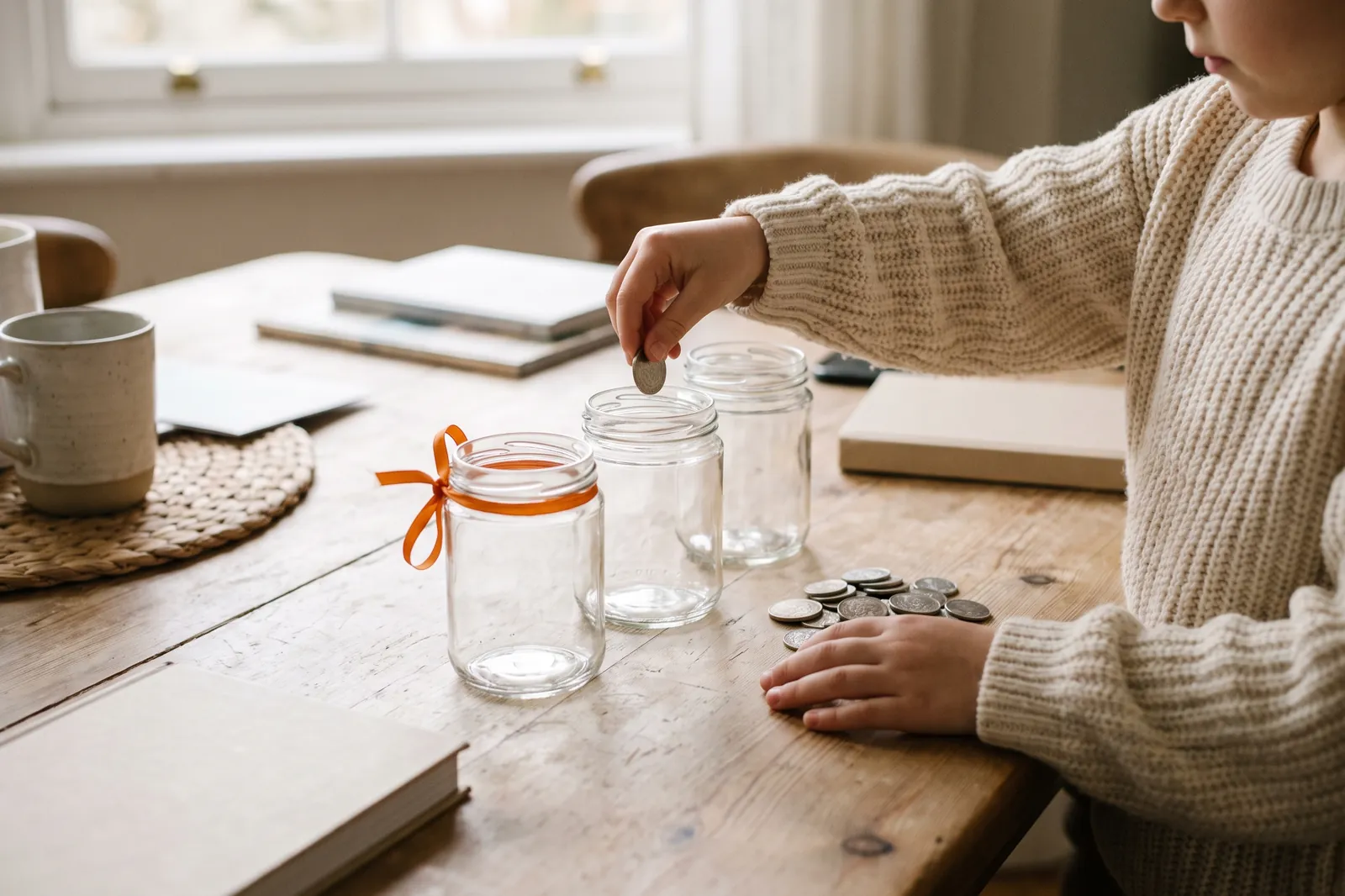
The fastest cure for “money is unlimited” is having a limited amount of your own. Birthday money, coins from a grandparent or a few dollars for a small job all work. Let your child keep it somewhere they can see, and let them decide how to use it. When they want something that costs more than they have, the problem becomes theirs to think about, gently, instead of yours to refuse.
A clear jar works well for this. Our guide to save, spend, share jars explains one simple way to set it up, and how to teach kids to save money covers the waiting part. If you are weighing a regular allowance, see allowance for kids by age.
Be kind to yourself about this
If your child has been treating you like a cash machine, nothing has gone wrong. They have been learning from what was in front of them. Every “the card is a key to our money” adds a piece they were missing. For the bigger picture of what children understand at each age, start with our guide on how to teach kids about money, and for the everyday skill of knowing what a dollar is worth, read how to teach kids the value of money.
Questions parents ask
Why does my child think we have unlimited money?
Because they see money come out of cards and machines but rarely see it go in. Cards stand for money rather than being money, which takes an extra step to understand, and a University of Cambridge review suggests children only begin to grasp the unseen transactions behind a payment after about age seven.
How do I explain an ATM to a child?
Keep it short: “The machine gives us our own money back from the bank. It can’t make new money.” Then connect it to work: you earn money, it goes into the bank, and the machine or card lets you use what is already yours.
How do I explain a credit or debit card to a 5 year old?
Call it a key, not money. “The card is a key to our money in the bank. Every time I tap it, some of our money goes to the store.” Saying the amount out loud at checkout, now and then, makes the trade easier to picture.
Should I tell my kids how much money we have?
You do not need to share exact numbers with young children. What helps is the shape of it: money comes from work, it is limited, and the family makes choices about it. Keep adult worries between adults and keep the message calm.
Sources
- 2026 Findings from the Diary of Consumer Payment Choice, Shaun O'Brien and Hailey Phelps
- Habit Formation and Learning in Young Children (May 2013), David Whitebread and Sue Bingham, University of Cambridge
- Money as You Grow: Young children (ages 3 to 5)
- Young children and shopping
- School-age children and saving
Written by the WonderLab Journal editorial desk and checked against the sources above. Found something out of date? Tell us through the corrections page.