A lemonade stand for kids: the first business lesson, step by step
Rules to check, what to buy, how to price a cup, sign ideas that work, the safety basics, and the ten-minute count-up at the end that turns a summer afternoon into a money lesson.
- 01Step 1: Check the local rules
- 02Step 2: Pick the day and the spot
- 03Step 3: Shop for supplies and write down every cost
- 04Step 4: Set a price kids can count
- 05Step 5: Lemonade stand sign ideas
- 06Step 6: Keep it clean and safe
- 07Lemonade stand ideas for the day itself
- 08Step 7: Count up the day
- 09Books about a lemonade stand for kids
- 10Our own set: two books about a small business
- 11Questions parents ask
- 12Sources
Check your local rules first, since some places require a permit and others, like Texas, protect kids’ stands by law. Set up on your own property with an adult there the whole time. Let your child help buy the supplies and write down what they cost, pick a simple price, make a big clear sign, and keep hands, cups and ice clean. At the end, count the money, subtract the costs and decide together what to do with what is left.
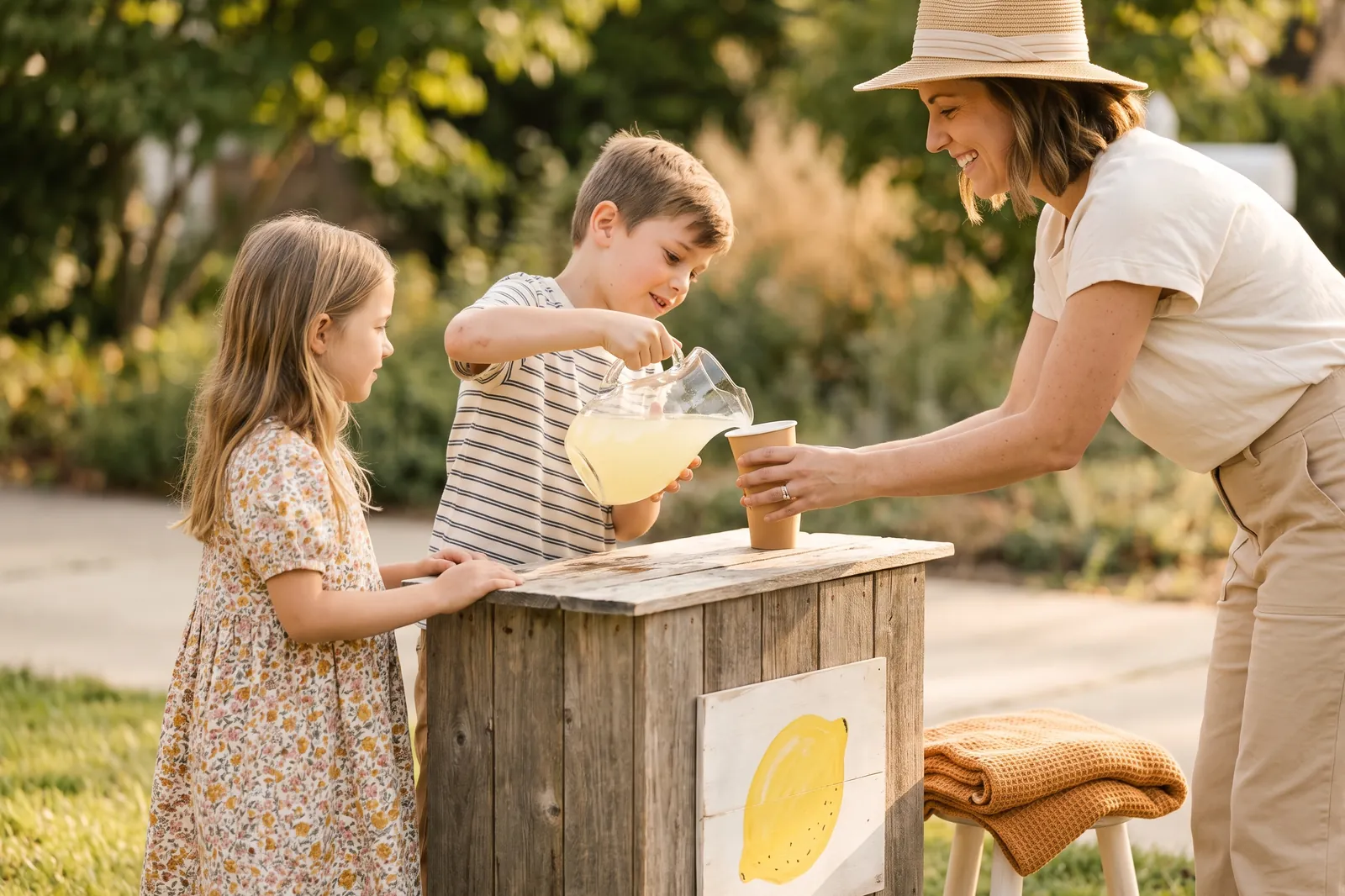
A lemonade stand for kids is the oldest business lesson in the neighborhood, and still one of the best. In one afternoon a child meets customers, costs, prices, slow stretches and the feeling of money they made themselves. The Consumer Financial Protection Bureau’s first money idea for young children is simple: “You need money to buy things, and you earn money by working.” A stand makes that idea something your child can hold in a cup.
Here is how to run a lemonade stand, step by step, so it is safe, legal and actually teaches something.
Step 1: Check the local rules
This is the step most families skip, and the one that matters most. In some cities and counties, selling food or drinks to the public technically requires a permit, even for kids. Other places have changed the rules. Texas, for example, passed a law in 2019 that stops cities, counties and local health authorities from requiring a license, permit or fee for the occasional sale of lemonade or other nonalcoholic drinks by someone under 18 from a stand on private property or in a public park. Several other states have considered or passed similar laws.
Because the rules differ by place and change over time, do a quick check before your stand opens: search your city or county website for “lemonade stand” or “temporary food permit,” or call the local health department. If you live in a community with a homeowners association, check its rules too. It takes ten minutes and saves a disappointing afternoon.
Step 2: Pick the day and the spot
- Your own yard or driveway is the easiest choice, or a friend’s with their permission.
- Stay off the street. Set the table well back from traffic so customers can stop safely.
- Choose busy, not hot. A Saturday morning or a day when neighbors are out works well. The AAP suggests limiting sun exposure between 10 a.m. and 4 p.m., when UV rays are strongest, so a morning stand or a shady spot is kinder on everyone.
- Keep it short. Two hours is plenty for a five or six year old.
Step 3: Shop for supplies and write down every cost
Take your child shopping and let them hold the list. You will need lemonade (fresh lemons and sugar, or a mix), water, ice, a pitcher, cups, a table, a cooler and a cash box or jar. This is where the real lesson starts: write down what each item costs. Those numbers come back at the end of the day.
Decide who pays for the supplies. Treating them as a small loan the stand pays back from sales teaches the most.
Step 4: Set a price kids can count
Pick a price that is easy to make change for, like 50 cents or a dollar. Round prices let a six year old handle the money with your help, and give a seven or eight year old a manageable change problem: “They paid with a dollar, the cup is 50 cents, so how much goes back?”
If your child is curious, ask: “How many cups do we need to sell to pay for the lemons and cups?” You do not need an exact answer. The question is the lesson.
Step 5: Lemonade stand sign ideas
A good sign does three jobs: says what you sell, says the price and can be read from a car. Let your child make it, with your help on spelling.
- Big, thick letters. Two or three words only: “COLD LEMONADE.”
- The price, huge. “50¢” in the biggest numbers on the sign.
- Bright color on white. Yellow and black, or red on white, stand out.
- A second sign down the sidewalk. An arrow and “Lemonade ahead” gives people time to stop.
- A drawing. A lemon, a cup or a sun.
Step 6: Keep it clean and safe
- An adult stays at the stand the whole time, and kids never go into a customer’s car or house.
- Wash hands before you start. The CDC lists before, during and after preparing food among the key times to wash, with soap and at least 20 seconds of scrubbing.
- Keep drinks and ice cold and covered in a cooler, and use a scoop or tongs for ice, not hands.
- Use a fresh cup for every customer. No refills into used cups.
- Protect your sellers from the sun. The AAP recommends shade, a wide-brimmed hat and broad-spectrum sunscreen of at least SPF 15, reapplied every two hours. Keep a water bottle for the staff, too.
- A grown-up keeps the cash box within reach, while your child does the counting.
Lemonade stand ideas for the day itself
- Give your child a job title. One pours, one takes money, one waves the sign. Rotate every half hour.
- Keep a tally. A tick mark for every cup sold shows which hour was busiest.
- Plan for quiet stretches. There will be one. That is real business, too. Ask: “Why do you think it’s slow? What could we try?”
- Consider a cause. Some kids like to give part of the money to an animal shelter or a school fund. Say so on the sign if you do.
- Be careful with add-ons. Homemade cookies are tempting, but selling homemade food can bring other rules in some places, so check first.
Step 7: Count up the day
This ten minutes is the part that makes a lemonade stand for kids a money lesson rather than just a fun afternoon. Sit down together with the cash box and the list from Step 3.
- Count the money. Sort the coins and bills and count each pile. Our guide on how to teach kids to count money can help with mixed coins.
- Subtract the costs. Take away what the lemons, sugar, cups and ice cost. What is left is the profit. If it is less than they hoped, or even zero, that is a genuinely useful discovery.
- Talk about it. “What sold best? What would you change next time?”
- Decide what to do with it. Spend some, save some, maybe give some. Our guide to save, spend, share jars covers that step.
Books about a lemonade stand for kids
Lemonade for Sale, by Stuart J. Murphy, illustrated by Tricia Tusa. Part of the MathStart series, it follows the Elm Street Kids as they sell lemonade and use a bar graph to track how many cups they sell each day. When business drops off, they have to figure out what to do. The publisher lists it for ages 6 to 10, and it pairs perfectly with the tally from your own stand.
The Lemonade War, by Jacqueline Davies. A chapter book for ages 8 to 12. With five days of summer vacation left, brother and sister Evan and Jessie start an all-out contest to see who can sell the most lemonade before school starts. Funny and full of business math, it makes a good read-aloud for an eight year old or an older sibling.
Our own set: two books about a small business
Full disclosure: we publish these. Two of the five picture books in The Money & Business Library are about a small business. In Lemon Inc., an idea becomes a real thing: customers, costs, a partner with opinions, one very quiet Tuesday. Lemon Inc.: Going Big is the hardest one, because it is about what happens when it works: spend it, or grow it? The set is for ages 4 to 8, with audiobook editions. Your child’s own stand will teach plenty on its own; the books are one more way to talk it through.
For more ways young kids can earn, see our guide to ways for kids to earn money.
Questions parents ask
Do kids need a permit for a lemonade stand?
It depends on where you live. Some cities and counties require a permit for selling food or drinks, while some states, such as Texas, have laws that stop local governments from requiring one for occasional sales by children. Check your city or county website or call the local health department before you open.
How much should kids charge for lemonade?
Pick a round price that is easy to make change for, such as 50 cents or a dollar. It keeps the money simple enough for a young child to handle with your help, and it makes counting up at the end of the day easier.
What age is good for a lemonade stand?
Many kids enjoy a stand from about age 5, with an adult running things alongside them. By 6 to 8, children can help shop, set the price, make the sign and count the money, which is when the business lessons really land.
What should kids do with lemonade stand money?
First pay back the supply costs, then decide together. Many families split what is left into spending, saving and giving. Talking through the choice teaches as much as the stand itself.
How do you make a lemonade stand sign?
Keep it short and big: two or three words like COLD LEMONADE, the price in the largest numbers, bright colors that can be read from a car, and a simple drawing of a lemon or a cup. A second arrow sign down the sidewalk helps people stop.
Sources
- Texas H.B. No. 234 (2019), relating to the local regulation of the sale of lemonade or other beverages by children
- Money as You Grow: Young children (ages 3 to 5)
- About Handwashing
- Sun Safety: Information for Parents About Sunburn and Sunscreen
- Lemonade for Sale, by Stuart J. Murphy, illustrated by Tricia Tusa
- The Lemonade War, by Jacqueline Davies
Written by the WonderLab Journal editorial desk and checked against the sources above. Found something out of date? Tell us through the corrections page.