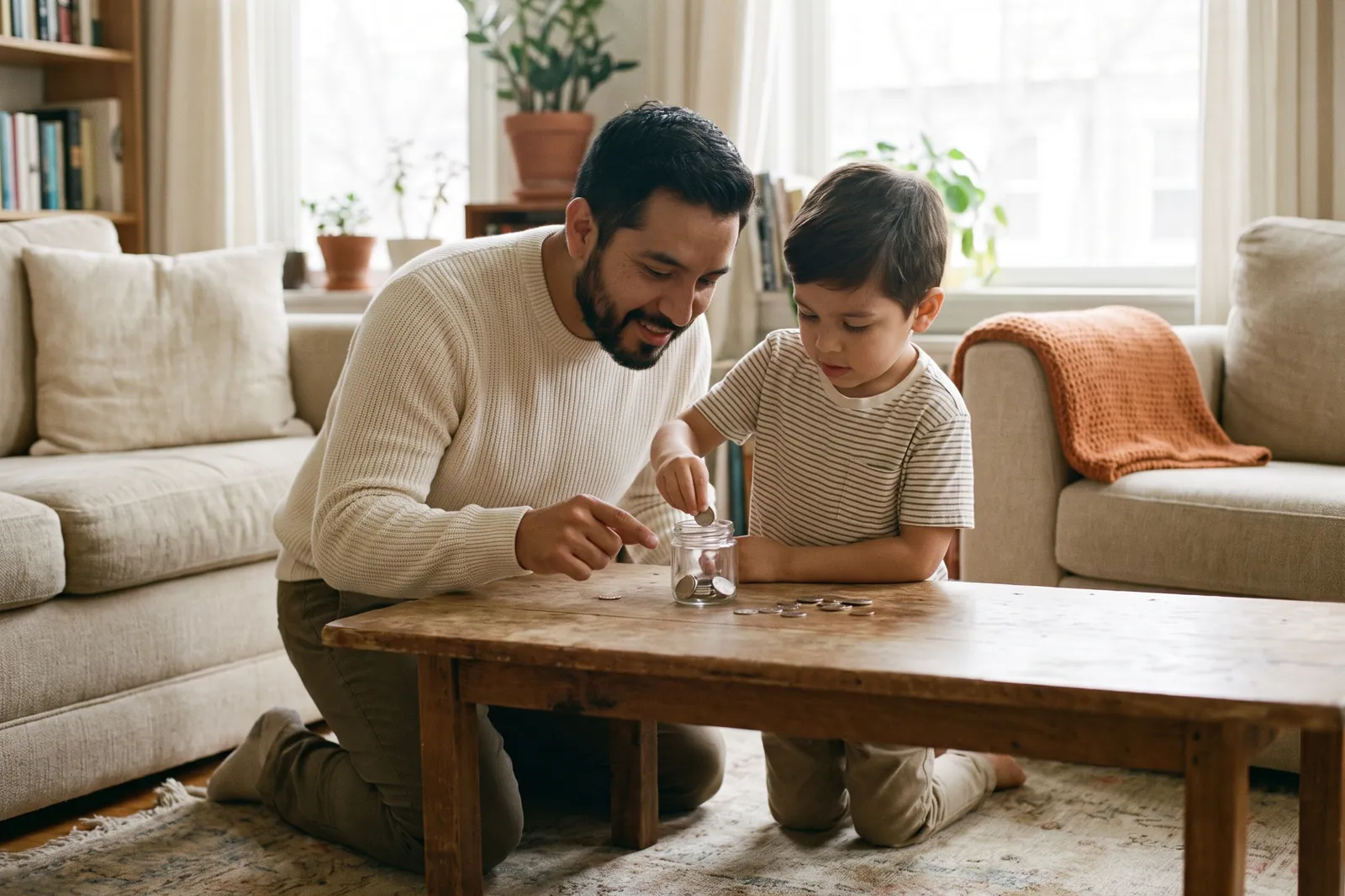
What age should kids learn about money? Earlier than most parents think
The research points to the preschool years, long before any school class on money. What changes between 3 and 8, why it matters, and the first small steps at each stage.
In this guide
The short answer
Around age 3. The Consumer Financial Protection Bureau’s research model finds that the skills behind good money habits, such as planning and self-control, develop rapidly between ages 3 and 5, and that money habits and norms begin to form between ages 6 and 12. Starting small and early, mostly through everyday moments, works better than waiting for a class.
Many parents assume money is a topic for later: for the first job, the first bank account, or the personal finance class in high school. So what age should kids learn about money? The research says much earlier than that. The first building blocks go in during the preschool years, and by the end of second grade a lot of the groundwork is already there.
That does not mean a four-year-old needs to learn about interest rates. It means the small things you already do, like paying at the store, saying “not today” or helping them wait for a birthday, are doing more teaching than you might think.
What age should kids learn about money, according to the research?
In 2016 the Consumer Financial Protection Bureau published a model of how children develop money skills. It describes three building blocks, typically acquired at different rates across three stages:
- Ages 3 to 5: executive function. The skills that let us plan ahead, focus, remember and hold back an impulse develop rapidly in these years. They are not about money yet, but saving and budgeting depend on them later.
- Ages 6 to 12: habits and norms. Children start to form their own money habits and rules of thumb, mostly by watching and interacting with the adults around them.
- Ages 13 to 21: knowledge and decision-making. Facts about banking, credit and comparing financial products mostly come later, as teens start making real decisions of their own.
A 2013 review for the UK’s Money Advice Service, by University of Cambridge researchers David Whitebread and Sue Bingham, reaches a similar conclusion from a different angle. “By the age of seven years,” it notes, “several basic concepts relating broadly to later ‘finance’ behaviours will typically have developed.” Those include counting, knowing that coins have different values, understanding that you have to pay and that some amounts are not enough, and a first sense of “later.”
So the honest answer is: start around three, with very simple ideas, and expect the most important habits to take shape between six and twelve.
Why earlier is better than most parents think
Habits form before lessons make sense
The Cambridge review found that teaching young children explicit money facts is likely to be ineffectual at changing their behavior, while what parents model, talk about and demonstrate is not. In other words, young children learn money the way they learn manners: from watching what the family does every day.
School mostly comes later
Most state requirements for personal finance education are aimed at high school. As of October 2026, Next Gen Personal Finance’s live tracker counts 30 states that require a standalone personal finance course for high school students, 11 of them fully in place and 19 still phasing in.
New York is a notable exception. In March 2026 the New York Board of Regents adopted an amendment to section 100.2 of the Commissioner’s regulations that requires personal finance instruction for public school students from kindergarten through grade 12. For the elementary band, instruction must be provided by the end of grade 4, and that band phases in starting with the 2027 to 2028 school year. Outside cases like that, the years from 4 to 8 are mostly left to families.
The early skills are the hard ones
Waiting, choosing between two things and understanding that money runs out are not facts. They are skills, and skills need years of small practice. The earlier your child gets that practice, the more natural it feels by the time the bigger numbers arrive.
Where to start at each age
Every child moves at their own pace, so treat these as starting points. For a fuller picture of what children understand at each stage, see our guide on how to teach kids about money.
Ages 3 to 4: money buys things, and sometimes we wait
- Let them hand over the money at a store.
- Name the wait: “We’ll get it after we save up.”
- Play pretend store with real coins.
Ages 5 to 6: choices, and saving for one thing
- Offer either-or choices at the store.
- Start a clear jar for one small goal. Our guide on how to teach kids to save money walks through it.
- Talk about needs and wants while you shop.
Ages 7 to 8: exchange, change and planning ahead
- Let them count the change and check it.
- Save toward a goal a few weeks away.
- Consider a small, regular amount to manage. See allowance for kids by age if you are weighing one.
Signs your child is ready for the next step
- They ask for things at the store, or ask “Why can’t we?”
- They notice coins and want to count them.
- They ask where money comes from, or think the card always works. If so, our guide my kid thinks I’m an ATM may help.
- They get a birthday card with money in it and want to spend it right away.
Each of these is an opening, not a problem. A question about money is the best moment to talk about money.
If you feel like you are late
You are not. Children keep forming money habits well into the preteen years, and the CFPB’s model has them building money skills right through the teen and young adult years, up to age 21. Whatever age your child is today, the next small conversation counts. Start with one habit from the list above and let the rest follow.
Worried that talking about money will make your child anxious? Keep it calm and factual, and frame money as choices rather than shortage. “We’re saving for the trip, so not today” teaches far more, and frightens far less, than adult worries shared out loud.
Questions parents ask
At what age do children understand money?
Gradually. Three and four year olds know money is for buying things, by five to six they see that some amounts are not enough, and around seven they begin to understand exchange and change. A University of Cambridge review notes that several basic concepts behind later money behavior are typically in place by age seven.
Is 3 too young to teach a child about money?
No, as long as you keep it simple. At three, teaching money means letting them hand over coins at a store, naming waits and playing pretend shop. The CFPB’s guidance for families starts at ages 3 to 5.
Do schools teach kids about money in elementary school?
Usually not as a required subject. Most state requirements focus on high school. New York is an exception: its regulations now require personal finance instruction by the end of grade 4, phasing in from the 2027 to 2028 school year.
When should a child get an allowance?
There is no single right age. The CFPB lists earning through an allowance or family jobs among its ideas for ages 6 to 12, and younger children often do not yet see an allowance as money they manage. Our guide to allowance for kids by age covers the details.
Sources
- Building blocks to help youth achieve financial capability: A new model and recommendations (September 2016) Consumer Financial Protection Bureau
- Habit Formation and Learning in Young Children (May 2013), David Whitebread and Sue Bingham, University of Cambridge Money Advice Service, now the Money and Pensions Service
- Personal Finance Education: Amendment of Section 100.2 of the Regulations of the Commissioner of Education New York State Education Department
- Live U.S. Dashboard: Guarantee States Next Gen Personal Finance
- Money as You Grow: Help for parents and caregivers Consumer Financial Protection Bureau
Links checked on October 12, 2026. Guidance changes; the publishers above keep the current version.
Written by the WonderLab Journal editorial desk and checked against the sources above. Found something out of date? Tell us through the corrections page.