Books about giving for kids: stories about sharing what you have
An ice cream cone, a plate of cookies, a quilt for a greedy king. Picture books that make generosity feel like something a child can actually do.

The best books about giving for kids show generosity at a child’s scale. For ages 3 to 5, start with Should I Share My Ice Cream? by Mo Willems and The Doorbell Rang by Pat Hutchins. For ages 5 to 7, Uncle Willie and the Soup Kitchen by DyAnne DiSalvo-Ryan and Somebody Loves You, Mr. Hatch by Eileen Spinelli show giving in a community. For ages 6 to 8, The Quiltmaker’s Gift by Jeff Brumbeau and Beatrice’s Goat by Page McBrier show what a gift can change. Then talk about it: research suggests that talking about giving matters.
December is when many families think about giving: food drives, toy collections, GivingTuesday, the coins dropped into a red kettle. For young children, though, “giving” can be an abstract word until a story makes it concrete. The books about giving for kids on this list do exactly that. They show a character with something to share, a moment of hesitation, and what happens next.
Every title below is a real, published book, checked against a library record or a publisher listing. We sorted them from the simplest sharing stories to bigger ideas about charity for older kids.
Books about giving for kids ages 3 to 5: sharing
Should I Share My Ice Cream?
An Elephant & Piggie early readerGerald has an ice cream cone and a big decision to make: should he share it with his best friend Piggie? He thinks it over so long that the decision almost makes itself. It is funny, short and captures the real tug of sharing something you love.
The Doorbell Rang
Sharing, with math built inMa has baked a plate of wonderful cookies. Then the doorbell rings, and more children arrive to share them, and then it rings again. Each time, the cookies have to be divided among more friends. Preschoolers love counting along, and the story shows that sharing can mean a smaller piece and a bigger party.
It’s Mine!
For the “mine!” stageThree frogs who live on an island in a pond spend their days quarreling over who owns what. Then a storm comes, and they discover what they gain by sharing. Lionni’s collage art is beautiful, and three and four year olds recognize the arguing instantly.
The Rainbow Fish
A modern classicThe Rainbow Fish has shimmering scales and is the most beautiful fish in the ocean, but he is proud, and none of the other fish want to be his friend until he learns to give some of his scales away. The foil scales make it irresistible to small hands. A good question afterward: “How did he feel before, and after?”
The Gift of Nothing
For the holidaysMooch the cat wants a present for his friend Earl the dog, but Earl already has everything he needs: a bowl, a bed, a chewy toy. So Mooch decides to give him nothing. A gentle, funny story about the gift of simply being together.
The Spiffiest Giant in Town
Rhyming, and generousGeorge the giant is known for his old patched clothes. He finally buys a smart new outfit, then gives it away, piece by piece, to animals in need on his way home. Young children love the rhymes and the growing pile of giveaways, and the ending feels earned.
Books about giving to neighbors and community, ages 5 to 7
Somebody Loves You, Mr. Hatch
A neighborhood storyMr. Hatch keeps to himself, until an anonymous valentine changes everything. He becomes a laughing friend who helps and appreciates all his neighbors, and the neighbors, in turn, find a way to give back to him. A warm story about how being noticed can change a person.
Uncle Willie and the Soup Kitchen
Giving time, not thingsA boy spends the day with his Uncle Willie at the soup kitchen where Willie helps prepare and serve meals. It is a calm, respectful look at the people who come to eat and the people who cook, drawn from the author’s own volunteer experience. A good book before volunteering together for the first time.
A Castle on Viola Street
Neighbors building togetherA hardworking family finally gets a home of its own by joining a community program that restores old houses, where neighbors work side by side. It ends with a note about housing organizations such as Habitat for Humanity, which makes it a natural start to a conversation about helping out.
The Can Man
For kids who are saving upA boy watches a homeless man in his neighborhood collect empty cans for the deposit money, and decides to collect cans himself to earn money for a skateboard. Then he has a change of heart. It connects earning, wanting and giving in one story, which makes it a strong choice for a child with a savings goal.
Books about generosity and charity for ages 6 to 8
The Quiltmaker’s Gift
A fable about having enoughA generous quiltmaker gives her quilts away, but she finally agrees to make one for a greedy king, on certain conditions. Those conditions lead to a real change of heart. The richly detailed pictures reward slow looking, and the story raises a great question: what actually makes people happy?
Beatrice’s Goat
Based on a true storyIn a small village in Uganda, a girl named Beatrice dreams of going to school. When her family is given a goat that can produce income, her dream comes true. Based on a true story about the work of a charity that gives farm animals to families, it shows children how a gift can keep on giving.
One Hen
For older kids in this rangeInspired by true events, it follows Kojo, a boy in Ghana who has to leave school to help his mother. With a tiny loan, he buys one hen, and over time builds a flock, returns to school and grows a farm that supports many people. It is longer and works best at seven or eight, read over two nights.
The Giving Tree
The classic, read with a questionA tree loves a little boy and gives him everything she has, from apples to branches, as he grows up. Families have argued about its meaning for more than fifty years, which is exactly what makes it worth reading with older kids. Afterward, ask: “What did the boy give the tree?” and see where the conversation goes.
How to talk with kids about giving
The story opens the door. The conversation afterward is what sticks. A 2013 study from the Women’s Philanthropy Institute at Indiana University’s Lilly Family School of Philanthropy, which followed 903 children ages 8 to 19, found that children whose parents talk to them about giving are 20 percent more likely to give to charity than children whose parents do not. Talking had a bigger effect than role modeling alone. Younger children were not part of that study, but the lesson travels well: do it, and say it out loud.
- Let them choose. An animal shelter, a food bank, a children’s hospital. A cause they picked means more than one assigned to them.
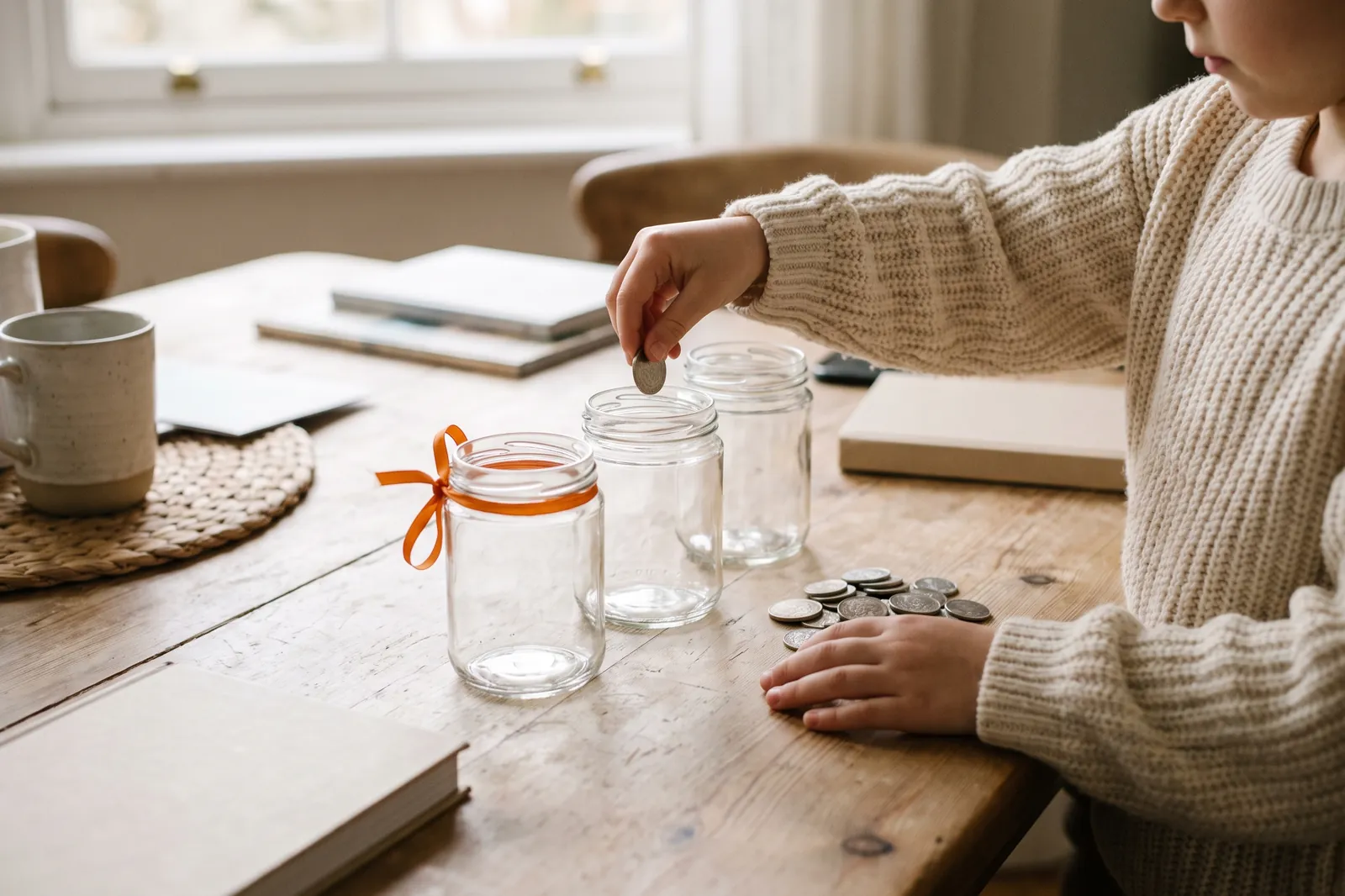
- Make it visible. A share jar next to the save and spend jars turns giving into a habit. Here is how save, spend, share jars work.
- Give time, too. Sorting outgrown clothes, picking food for a food drive or baking for a neighbor all count, and young children can do them.
- Talk about how it felt. “How do you think they felt when they opened it? How did you feel?”
Giving and gratitude go hand in hand. For more, see how to raise grateful kids and our list of books about gratitude.
Giving also starts with understanding that money comes from somewhere. Our own set, The Money & Business Library, is five illustrated picture books for ages 4 to 8 that follow money from a first dollar to a small business. Full disclosure: we publish it. It sits alongside these stories as a companion, not a replacement, and our hub on how to teach kids about money covers the bigger picture.
Questions parents ask
What are good books about giving for kids?
For ages 3 to 5, try Should I Share My Ice Cream? by Mo Willems and The Doorbell Rang by Pat Hutchins. For ages 5 to 7, Uncle Willie and the Soup Kitchen by DyAnne DiSalvo-Ryan and Somebody Loves You, Mr. Hatch by Eileen Spinelli. For ages 6 to 8, The Quiltmaker’s Gift by Jeff Brumbeau and Beatrice’s Goat by Page McBrier.
How do you explain charity to a young child?
Keep it concrete: some people do not have enough food, a warm coat or a home, and we can help. Let your child choose a cause, give something they can see or hold, like food for a food drive, and talk afterward about how it felt. Stories make a good starting point.
At what age can kids start giving to charity?
Preschoolers can take part in simple ways, like choosing a toy to donate or picking food for a food drive. A share jar alongside save and spend jars helps school-age children make giving a regular habit with their own coins.
Is The Giving Tree a good book about giving?
It is a classic that families read in different ways, which makes it a good conversation starter for older kids. Read it together and ask open questions, such as what the boy gave the tree, rather than offering one lesson.
Sources
Written by the WonderLab Journal editorial desk and checked against the sources above. Found something out of date? Tell us through the corrections page.