Dialogic reading: how to read with your child, not just to them
A simple way to turn story time into a conversation, developed by psychologist Grover Whitehurst: you ask, your child tells, and the book becomes theirs.
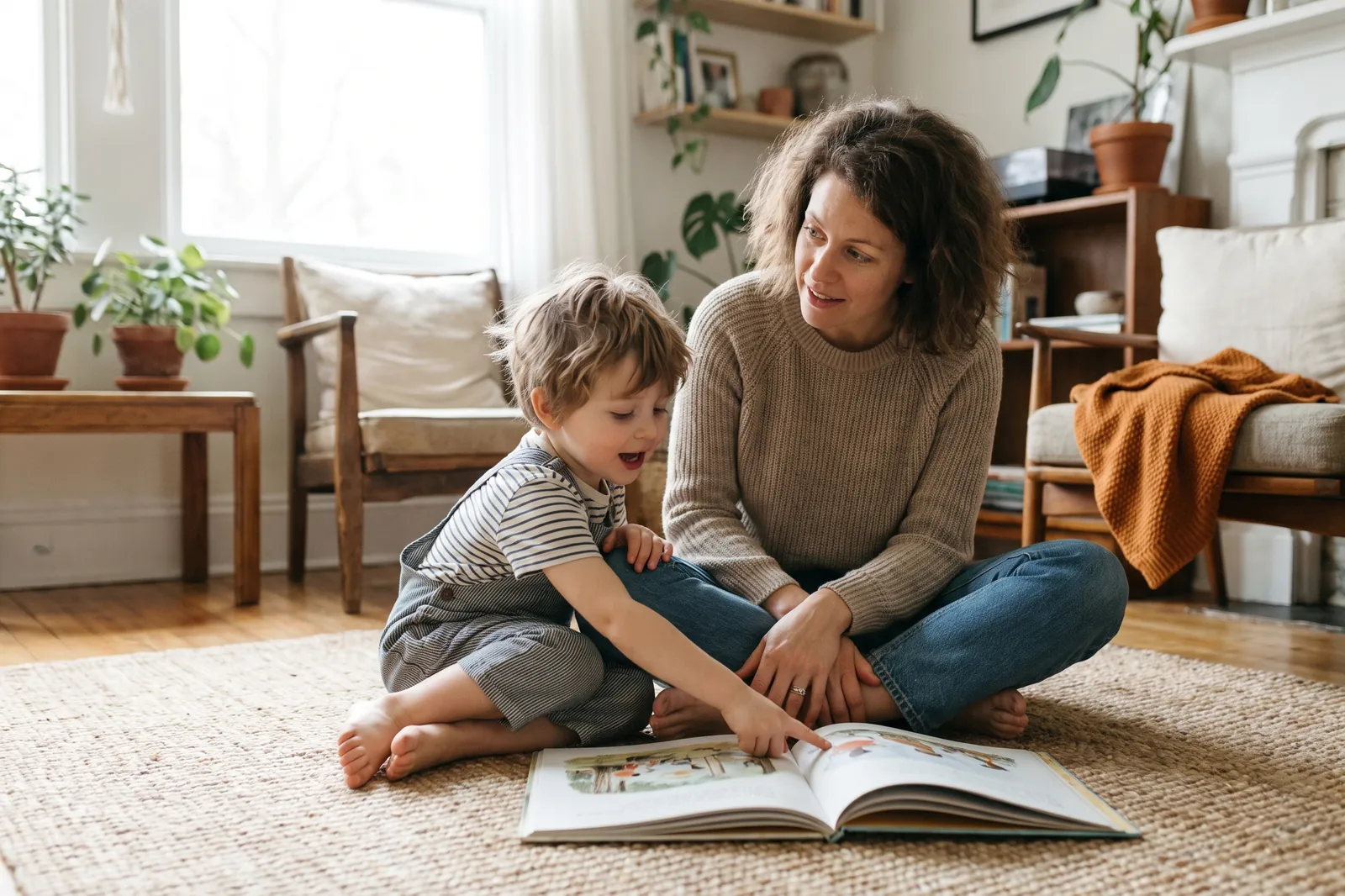
Dialogic reading is a way of reading picture books in which the adult helps the child become the storyteller. Developed by psychologist Grover Whitehurst and colleagues at Stony Brook, it uses a short routine called PEER (prompt, evaluate, expand, repeat) and five kinds of prompts called CROWD. Studies reviewed by the What Works Clearinghouse found positive effects on preschoolers’ oral language.
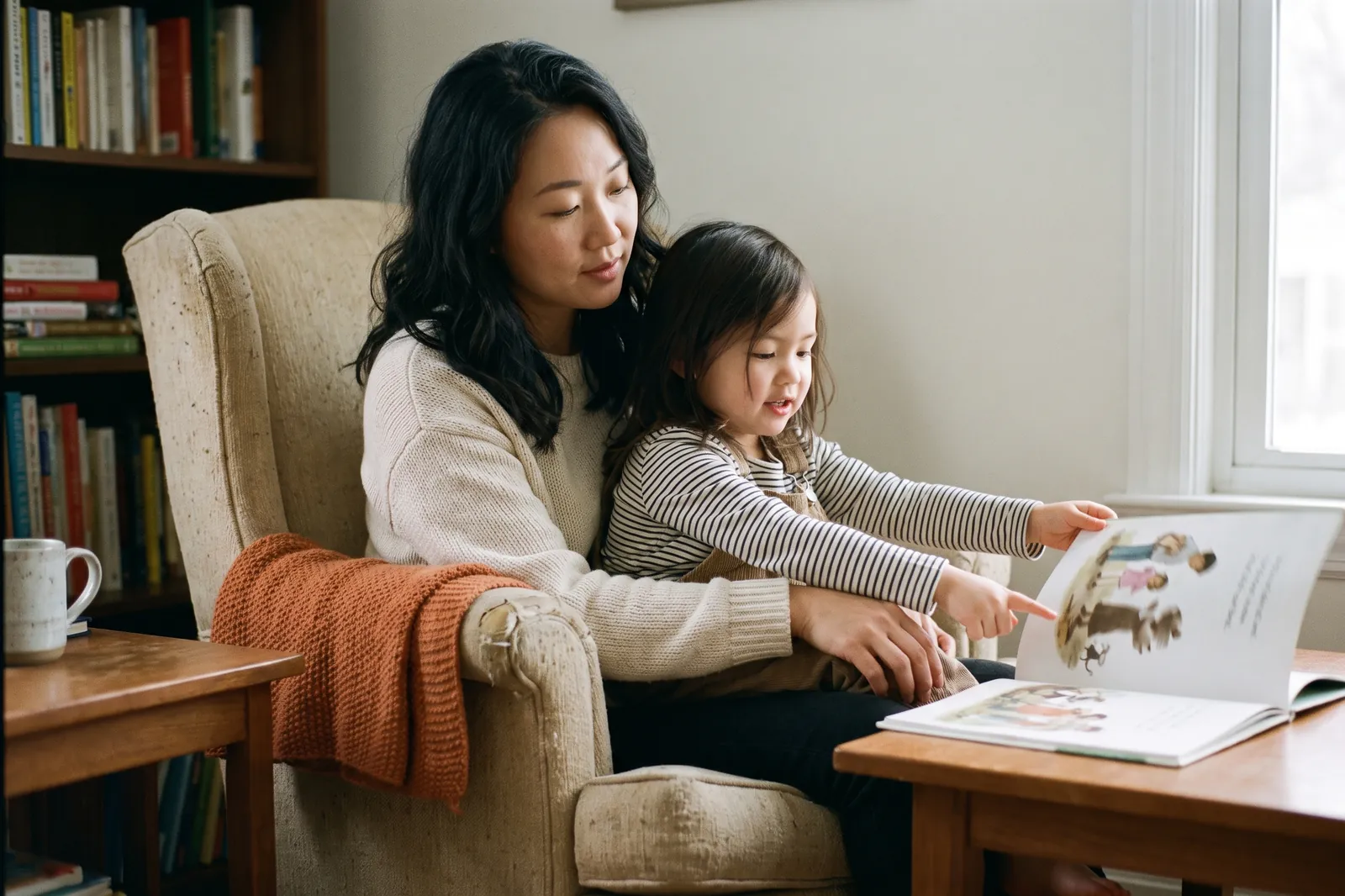
Most of us read to children the way we were read to: we read, they listen. Dialogic reading flips a little of that around. The adult asks, listens and adds, and the child does more and more of the telling. It sounds like a teaching technique, and it is one, but in practice it feels like a chat about a book you both like.
As Grover Whitehurst, who developed the method with the Stony Brook Reading and Language Project, wrote for Reading Rockets: “In dialogic reading, the adult helps the child become the teller of the story. The adult becomes the listener, the questioner, the audience for the child.”
What the research found
The method grew out of a study Whitehurst and colleagues published in Developmental Psychology in 1988, “Accelerating language development through picture book reading.” It tested a one-month, home-based program. Parents in one group were coached to ask more open-ended questions, ask about what things do and what they are like, expand on their child’s answers, and do less straight reading and fewer questions that could be answered by pointing. Parents in the other group read the way they usually did.
After the month, children in the coached group scored significantly higher on standardized tests of expressive language, and in recordings of their reading sessions they used longer utterances and more phrases rather than single words. Nine months later, the difference was still there, though smaller.
Independent reviewers have looked at the later studies too. The What Works Clearinghouse, run by the U.S. Department of Education’s Institute of Education Sciences, reviewed the studies that met its standards and rated dialogic reading as having positive effects on preschoolers’ oral language. It found no discernible effects on phonological processing, the sound skills behind decoding. That is a useful, honest boundary: dialogic reading grows talk and vocabulary. It is not a phonics program.
The PEER sequence
PEER is the basic move, a short exchange you can repeat on almost any page. The adult:
- Prompts the child to say something about the book,
- Evaluates the response,
- Expands it by rephrasing and adding information, and
- Repeats the prompt so the child can try the fuller version.
Whitehurst’s own example: you point to a fire engine and ask, “What is this?” Your child says, “Truck.” You answer, “That’s right, it’s a red fire truck. Can you say fire truck?” Prompt, evaluate, expand, repeat. Four seconds, and your child has a new word and a longer phrase.
The five CROWD prompts
CROWD is a memory aid for the five kinds of prompts that start a PEER sequence.
C is for completion
Leave a blank at the end of a sentence for your child to fill, especially in rhyming or repetitive books. Whitehurst’s example: “I think I’d be a glossy cat. A little plump but not too ____.” Completion prompts help children hear the structure of language.
R is for recall
Ask about what happened in a book you have read before: “Can you tell me what happened to the little blue engine in this story?” Recall prompts build an understanding of plot and sequence, and they work at the start of a reread as well as at the end.
O is for open-ended
Point to a detailed picture and say, “Tell me what’s happening here.” These prompts encourage children to talk in their own words and notice details.
W is for wh- questions
What, where, when, why and how: “What’s the name of this?” “Why do you think she’s hiding?” Wh- questions are especially good for teaching new vocabulary.
D is for distancing
Connect the book to your child’s life: “Remember when we went to the farm? Which of these animals did we see there?” Distancing prompts build a bridge between books and the real world, and they help with conversation and storytelling.
Dialogic reading strategies by age
- Toddlers and young 3s: lean on completion, open-ended and wh- prompts, which are the easiest. Pointing and naming is a great start.
- Ages 4 and 5: add recall and distancing prompts. Whitehurst notes these are harder, and suggests saving frequent use of them for four and five year olds.
- Ages 6 to 8: the method was developed for preschoolers, but the habit carries on naturally. Ask what a character should do, what they would have done, and why.
How to read to a child the dialogic way, starting tonight
- Read it straight the first time. Whitehurst suggests PEER on nearly every page except on the first reading of a book. Let the story land first.
- Pick a book with rich pictures or one your child already loves. Almost any picture book works.
- On the reread, ask one question per page, then wait. The pause is where the talking happens.
- Read less of the text each time. As the book becomes familiar, let your child tell more of it.
- Keep it light. Mix prompts with plain reading and follow your child’s interest. If they want to just listen tonight, that is fine too.
Whitehurst sums it up in three words worth keeping: “Keep it fun.” Children enjoy dialogic reading more than traditional reading, he writes, as long as you vary what you do and do not push more prompts than they can handle happily.
Why the conversation matters beyond reading
The same idea, that children learn more from talking with an adult than from being told, shows up across early childhood research. A University of Cambridge review of how young children form habits found that explicit lessons are unlikely to change young children’s behavior, while what parents model and discuss is likely to. A book you talk about together is one of the easiest places for that kind of conversation to happen, whether the topic is feelings, fairness or money. See our guides on how to teach kids about money and the benefits of reading to children.
Questions parents ask
What is dialogic reading?
Dialogic reading is an interactive way of reading picture books in which the adult asks questions, listens and adds to the child’s answers, so the child gradually becomes the storyteller. It was developed by psychologist Grover Whitehurst and colleagues at Stony Brook.
What does PEER stand for in dialogic reading?
PEER stands for prompt, evaluate, expand and repeat. The adult prompts the child to say something about the book, evaluates the answer, expands it with a little more language, and repeats the prompt so the child can try the fuller version.
What are the CROWD prompts?
CROWD names the five kinds of prompts used in dialogic reading: completion (fill in the blank), recall (what happened), open-ended (tell me about this picture), wh- questions (what, where, when, why, how) and distancing (connect the book to the child’s own life).
What age is dialogic reading for?
It was developed and studied mainly with toddlers and preschoolers. Completion, open-ended and wh- prompts suit younger children, while Whitehurst suggests saving frequent recall and distancing prompts for four and five year olds. The conversational habit works well with older children too.
Does dialogic reading work?
The evidence is good for language. Whitehurst’s 1988 study found higher expressive language scores after a one-month home program, and the What Works Clearinghouse rated dialogic reading as having positive effects on preschoolers’ oral language, with no discernible effects on phonological processing.
Sources
- Dialogic Reading: An Effective Way to Read Aloud with Young Children, by Grover J. (Russ) Whitehurst
- Accelerating language development through picture book reading, Whitehurst, Falco, Lonigan and colleagues, Developmental Psychology, 24(4), 552 to 559, 1988
- Accelerating Language Development through Picture Book Reading (ERIC record EJ375345)
- Dialogic Reading: WWC summary of evidence
- Habit Formation and Learning in Young Children (May 2013), David Whitebread and Sue Bingham, University of Cambridge
Written by the WonderLab Journal editorial desk and checked against the sources above. Found something out of date? Tell us through the corrections page.