The benefits of reading to children, backed by research
More words, a closer bond, calmer evenings and a head start on school. What the research actually shows, and why the cuddle on the couch is the point.

- 011. It builds the bond between you
- 022. It adds up to a lot of words
- 033. It supports language and early literacy
- 044. It lights up the parts of the brain that make stories come alive
- 055. It can help with behavior, too
- 066. Talking about the book doubles the value
- 077. Rereading the same favorite is not a rut
- 088. It sets up school, and it gives you a calm end to the day
- 09Benefits of reading to children: the statistics at a glance
- 10What if you can’t read every day?
- 11Questions parents ask
- 12Sources
Reading to children builds vocabulary and language, strengthens the parent-child bond and supports school readiness. The American Academy of Pediatrics recommends shared reading from birth and at least through kindergarten. One estimate from Ohio State researchers: a child read one picture book a day hears about 78,000 words a year from books alone. Talking about the story as you go makes the benefits bigger.
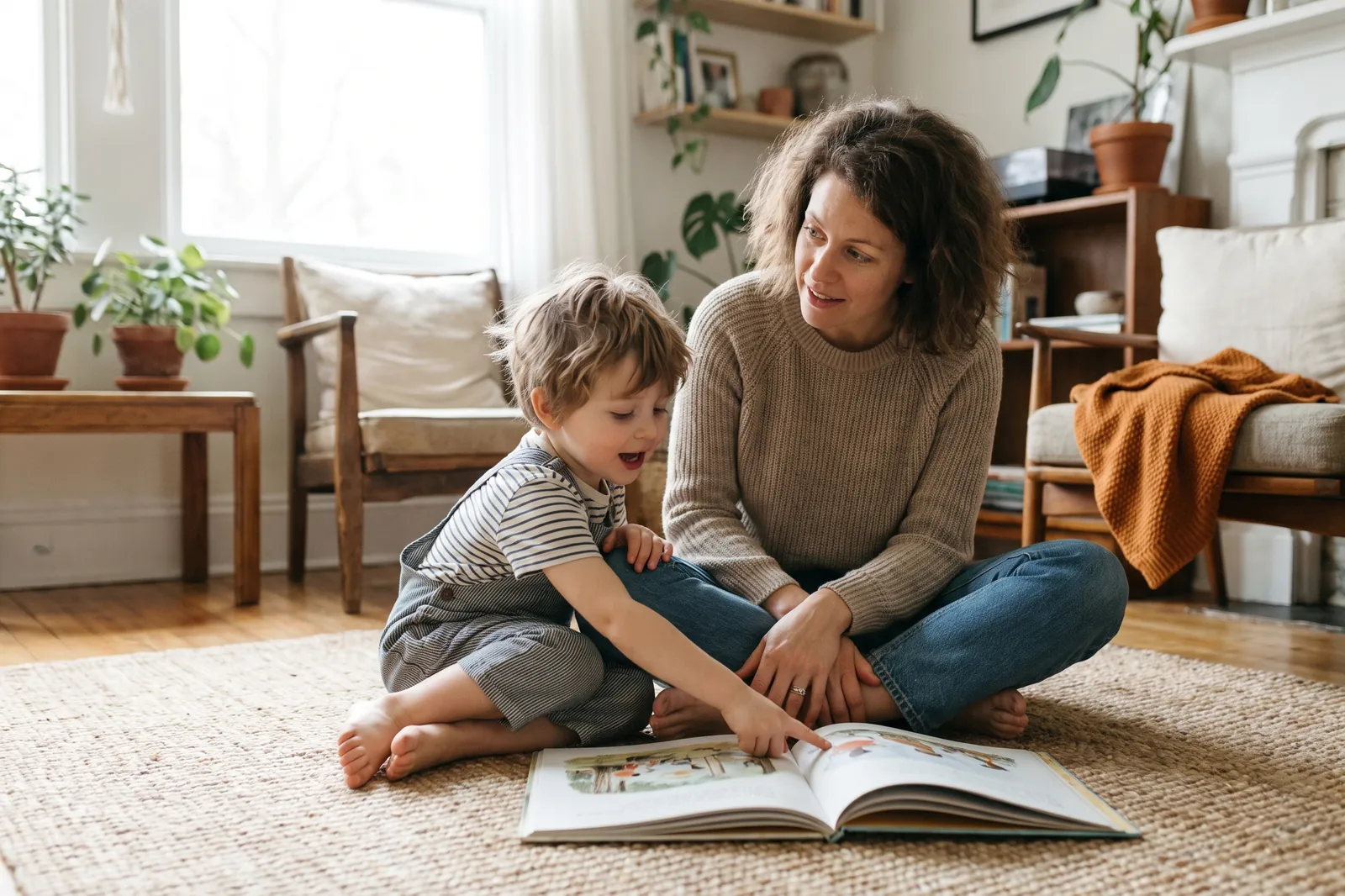
If reading to your child is already the best part of your evening, here is some good news: the research agrees with you. The benefits of reading to children reach well beyond learning letters. Studies link shared reading to bigger vocabularies, stronger early language, calmer behavior and closer relationships, and the American Academy of Pediatrics now calls it a positive parenting practice in its own right.
Below, each benefit comes with the study or statement behind it, and an honest note on what that research can and cannot tell us.
1. It builds the bond between you
In 2024 the AAP updated its policy statement on literacy for the first time since 2014. The headline was not phonics. It was relationships. The AAP describes shared reading as a chance to foster loving, nurturing relationships during a critical time of brain development, and recommends that pediatricians encourage it from birth and at least through kindergarten.
Dr. Perri Klass, lead author of the statement, put it this way: “Reading together with young children weaves joyful language and rich interactive moments into the fabric of daily life.” Children who first meet books in a parent’s arms, she added, arrive at school associating reading with lap-time, security and the voices of the people they love.
2. It adds up to a lot of words
Books use words that rarely come up in everyday talk at home. A 2019 study by Jessica Logan and colleagues at Ohio State, published in the Journal of Developmental and Behavioral Pediatrics, counted the words in popular board books and picture books and estimated what children hear from them. Their finding: a parent who reads one picture book a day exposes a child to an estimated 78,000 words a year from books alone.
Over the five years before kindergarten, they estimated, children in literacy-rich homes hear about 1.4 million more words during story time than children who are never read to. These are calculations, not measurements of real children, and the authors note they are likely conservative, because parents also chat about the pictures and the story. For the full numbers by reading frequency, see our guide to how many books to read to your child a day.
3. It supports language and early literacy
The link between reading aloud and later language is one of the better-studied ideas in early childhood. A 1995 meta-analysis by Adriana Bus, Marinus van IJzendoorn and Anthony Pellegrini pooled the studies on how often parents read to preschoolers. Reading together was related to language growth, emergent literacy and reading achievement, with an overall effect size the authors say explains about 8% of the variance in those outcomes. The effect held regardless of family income.
One honest caveat from the same paper: the effect seemed to get smaller once children could read on their own. That is not a reason to stop reading together. It is a reason to enjoy the early years, when it matters most.
4. It lights up the parts of the brain that make stories come alive
In a 2015 study in Pediatrics, John Hutton and colleagues used functional MRI to watch the brains of preschoolers listening to stories. Children from homes with more reading showed greater activation in a left-sided brain region that supports language meaning, mental imagery and understanding stories, even after accounting for household income. It is a correlation, not proof that reading caused the difference, but it fits what parents see: the child who has been read to can picture the story.
5. It can help with behavior, too
This one surprises people. In a randomized controlled trial published in Pediatrics in 2018, Alan Mendelsohn and colleagues at NYU tested a program, delivered at pediatric checkups, that encouraged parents to read aloud and play with their children. At age four and a half, children in the program showed fewer behavior problems, including a notable reduction in hyperactivity, compared with children who did not take part. Reading aloud and play were delivered together, so the study cannot separate the two, but the authors concluded that promoting both can support social-emotional development.
6. Talking about the book doubles the value
How you read matters as much as how often. In a well-known 1988 study, psychologist Grover Whitehurst and colleagues taught parents to ask open-ended questions and expand on their child’s answers while reading picture books. After one month, those children scored significantly higher on tests of expressive language than children whose parents read as usual. This approach, later named dialogic reading, is easier than it sounds: ask, listen, add a little, repeat.
7. Rereading the same favorite is not a rut
If your child asks for the same book every night, take heart. In a 2011 study, Jessica Horst and colleagues at the University of Sussex read storybooks with new words to 3-year-olds. Children who heard the same stories repeatedly learned and remembered the new words. Children who heard different stories each time, with the same new words, did not learn them. Familiar stories give children room to notice the details.
8. It sets up school, and it gives you a calm end to the day
Dr. Klass notes that reading proficiency by third grade is a significant predictor of high school graduation and career success. That is a long way off for a four-year-old, which is the point: the foundation is laid in moments that feel like nothing more than a story before bed. Dr. Klass also suggests making books part of the bedtime routine, to connect and wind down after a busy day. On the nights it works, it is good for both of you.
Benefits of reading to children: the statistics at a glance
- From birth, at least through kindergarten: the AAP’s recommendation for shared reading (2024 policy statement).
- About 78,000 words a year: estimated exposure from one picture book a day (Logan and colleagues, 2019).
- About 1.4 million more words by kindergarten: estimated difference between children in literacy-rich homes and children never read to (same study).
- About 8% of the variance: how much of the differences in language, emergent literacy and reading outcomes was explained by parent-preschooler reading in a 1995 meta-analysis (Bus and colleagues).
- One month: the length of the home intervention after which children of parents trained in dialogic reading scored higher on expressive language (Whitehurst and colleagues, 1988).
What if you can’t read every day?
Then read when you can. None of these benefits depends on a perfect streak, and the studies above describe patterns across months and years, not single evenings. A short book on a busy night counts. So does a story told in the car, or an audiobook you talk about afterward. If you want ideas for making it easier, see how to get kids interested in reading.
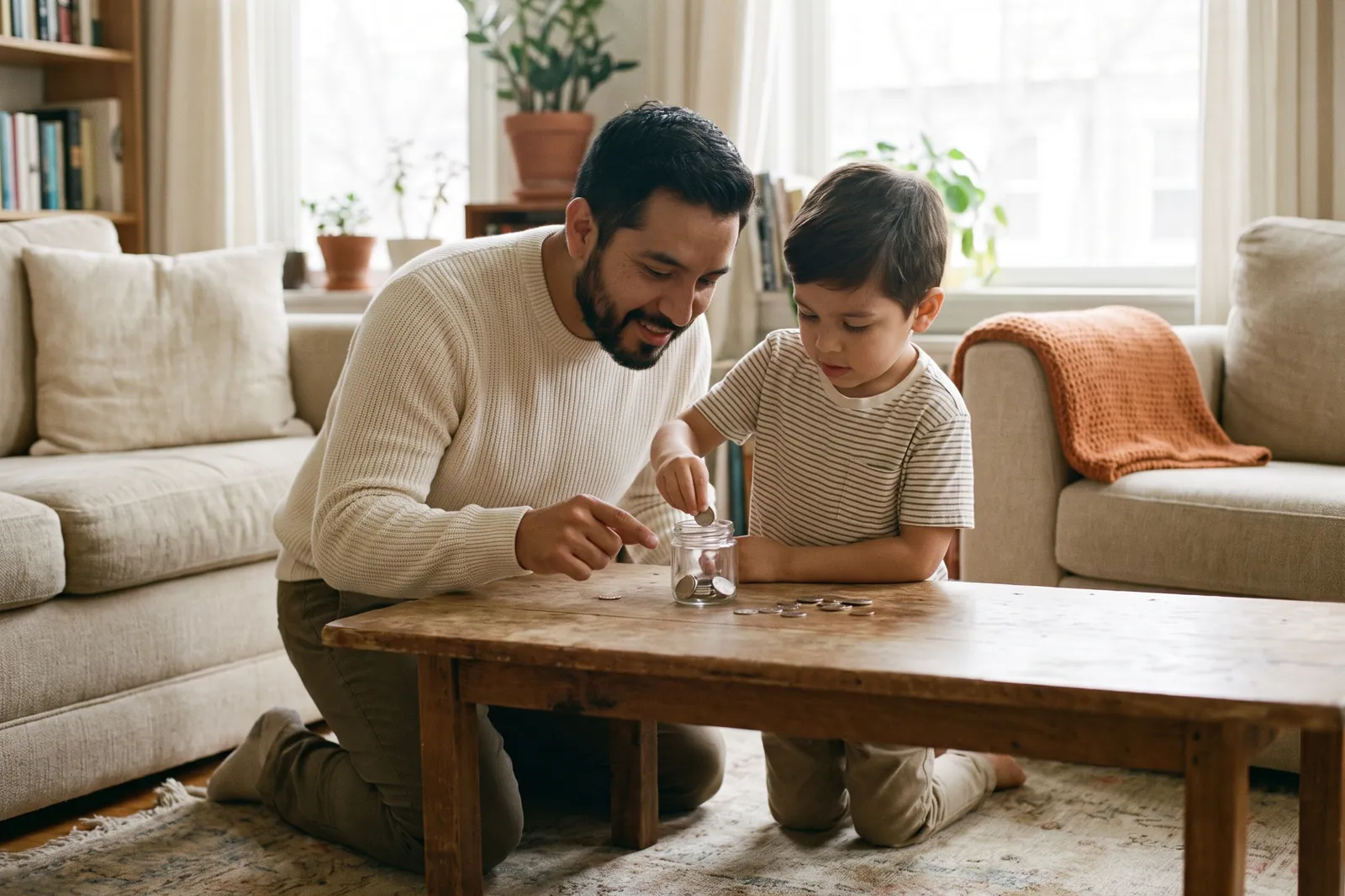
Shared reading is also one of the easiest places to talk about things that are hard to bring up cold, from feelings to fairness to what things cost. Researchers at the University of Cambridge who reviewed how young children form habits concluded that explicit lessons are unlikely to change young children’s behavior, while what parents model and talk about is likely to. A story gives you the opening. Our guide on how to teach kids about money shows how that works for one big topic.
Questions parents ask
At what age should you start reading to your child?
From birth. The American Academy of Pediatrics recommends that pediatricians encourage shared reading beginning at birth and continuing at least through kindergarten. With babies, it is mostly about closeness, your voice and looking at pictures together.
What are the benefits of reading to children every day?
Daily reading adds up: researchers at Ohio State estimate that one picture book a day exposes a child to about 78,000 words a year from books alone. Regular shared reading is also linked to stronger language, closer parent-child bonds and a calmer bedtime routine. Missing a day does not undo any of it.
Does reading to your child make them smarter?
Reading together is linked to stronger vocabulary, language and early literacy skills, which help at school. It is better to think of it as building language and a love of stories than as a way to raise a score. The relationship around the book is a large part of the benefit.
Should I keep reading to my child after they learn to read?
Yes. The AAP’s advice for parents is to keep reading to and with your child after they learn to read, because it keeps building connection. Read-alouds also let children enjoy stories that are still too hard to read on their own.
Sources
- Beyond Literacy: Shared Reading Starting at Birth Offers Lifelong Benefits (September 2024)
- Literacy Promotion: An Essential Component of Primary Care Pediatric Practice: Policy Statement, Pediatrics, 2024
- When Children Are Not Read to at Home: The Million Word Gap, Logan, Justice, Yumuş and Chaparro-Moreno, Journal of Developmental and Behavioral Pediatrics, 2019
- Joint Book Reading Makes for Success in Learning to Read: A Meta-Analysis on Intergenerational Transmission of Literacy, Bus, van IJzendoorn and Pellegrini, 1995
- Home Reading Environment and Brain Activation in Preschool Children Listening to Stories, Hutton and colleagues, Pediatrics, 2015
- Reading Aloud, Play, and Social-Emotional Development, Mendelsohn and colleagues, Pediatrics, 2018
- Accelerating Language Development through Picture Book Reading, Whitehurst and colleagues, Developmental Psychology, 1988
- Get the Story Straight: Contextual Repetition Promotes Word Learning from Storybooks, Horst, Parsons and Bryan, Frontiers in Psychology, 2011
- 10 Tips to Help Your Child Fall in Love with Reading
Written by the WonderLab Journal editorial desk and checked against the sources above. Found something out of date? Tell us through the corrections page.