Delayed gratification in kids: what the marshmallow test really says
The famous marshmallow test made waiting sound like destiny. Newer research tells a more modest, and more hopeful, story. What it means for your child and your family’s money habits.

Delayed gratification is choosing to wait for something better instead of taking something smaller now. The marshmallow studies of the late 1960s and 1970s linked longer waiting at age 4 to later success, but a larger 2018 replication found that link was about half as strong and shrank by two thirds once family background and early abilities were accounted for. Waiting is a skill shaped by trust, strategies and the people around a child, and it can be practiced.
Few experiments are as famous as the marshmallow test: a preschooler, one treat on the table, and a choice between eating it now or waiting to get two. The videos are funny and a little heartbreaking, and the story attached to them was big. Children who waited longer, it was said, did better in life. If you have been reading about delayed gratification in kids, you have probably met that story, and maybe worried about your own child who would have eaten the marshmallow in four seconds.
The research is real. The story turned out to be smaller and more interesting than the headlines. Here is what the studies found, what changed, and what it means at home.
What is delayed gratification for kids?
Delayed gratification means giving up something you could have now in exchange for something better later. For a young child, that might look like:
- Saving birthday money for a bigger toy instead of spending it on candy today.
- Waiting for a turn on the swing instead of grabbing it.
- Finishing a puzzle before going out to play.
- Waiting until after dinner for dessert.
It is closely tied to money. A University of Cambridge review for the UK’s Money Advice Service describes the ability to plan and to delay gratification as being at the root of saving. The Consumer Financial Protection Bureau’s conversation starter for ages 3 to 5 says the same thing in plain words: “Some things are worth waiting for.”
The original marshmallow studies
Starting in the late 1960s, psychologist Walter Mischel and his colleagues ran a series of experiments at the preschool on Stanford University’s campus. A child could take one small treat right away, or wait until the researcher came back and get a larger reward.
Much of the early work was about how children manage to wait. In a 1972 study, Mischel, Ebbe Ebbesen and Antonette Zeiss found that distraction mattered: children who were encouraged to think fun thoughts waited longer, while thinking about the treats themselves made waiting harder. Later reviews of the program describe other conditions too, such as covering the treats or coaching children with strategies.
Then came the follow-ups. In papers published in 1988, 1989 and 1990, the team reported that children who had waited longer as 4 year olds became more cognitively and socially competent adolescents, with higher scholastic performance and better coping with frustration and stress. Those findings, and the videos, made the marshmallow test one of the best-known results in developmental psychology.
There was a catch that got less attention. As a later team pointed out, the long-term results came from very small, highly selective groups of children from the Stanford University community, between 35 and 89 children depending on the analysis. Of the original 653 preschoolers, the researchers were able to contact only 185 for the adolescent follow-up.
What the 2018 replication found
In 2018, Tyler Watts, Greg Duncan and Haonan Quan published a conceptual replication in Psychological Science. They used data from a large federal study of child development run by the National Institute of Child Health and Human Development, with a much more diverse group of children. Their main analysis focused on 552 children whose mothers had not completed college. The children took a version of the marshmallow test at 54 months, about four and a half, with a maximum wait of 7 minutes. Researchers then looked at their achievement at age 15.
What they found was more modest:
- Each additional minute waited at age 4 predicted a gain of about one tenth of a standard deviation in achievement at 15. That is a real association, but only half the size of those reported in the original studies.
- Once the researchers accounted for family background, early cognitive ability and the home environment, the association shrank by two thirds.
- Most of the difference came from whether a child could wait at least 20 seconds, not from waiting the full 7 minutes.
- Links between waiting and behavior at age 15 were much smaller and rarely statistically significant.
In other words, the ability to wait at four is not a crystal ball. Much of what the original studies picked up seems to reflect the wider circumstances children grow up in. The authors themselves noted that a program that only boosts a child’s waiting, without changing broader skills, may do little for later outcomes.
Waiting depends on more than willpower
Other studies help explain why. Three are worth knowing:
- Trust. In a 2013 study by Celeste Kidd, Holly Palmeri and Richard Aslin, 28 children aged three and a half to almost six first saw a researcher either keep or break a promise. Those who had seen her keep it waited about 12 minutes on average before eating the marshmallow. Those who had seen her break it waited about 3. Waiting is partly a smart bet on whether the reward will really come.
- The group. In 2018, Sabine Doebel and Yuko Munakata found that 3 to 5 year olds waited longer when they believed children in their own group waited and another group did not. What the people around a child do matters.
- The times. Contrary to what most adults predicted, a 2018 analysis by Stephanie Carlson and colleagues of 840 children found that preschoolers in the 2000s waited on average about 2 minutes longer than children in the 1960s, out of a maximum of 10. The authors call for more research before drawing firm conclusions.
What this means for parents
- Don’t test your child at home. A quick snack-on-the-table test says very little about their future. The research does not support treating it as a verdict.
- Keep your promises about “later.” If you say you will go to the park after the errand, go. Reliable adults make waiting a reasonable choice.
- Teach a strategy, not just a rule. Out of sight, out of mind is real. Put the treat away, sing a song, start a game.
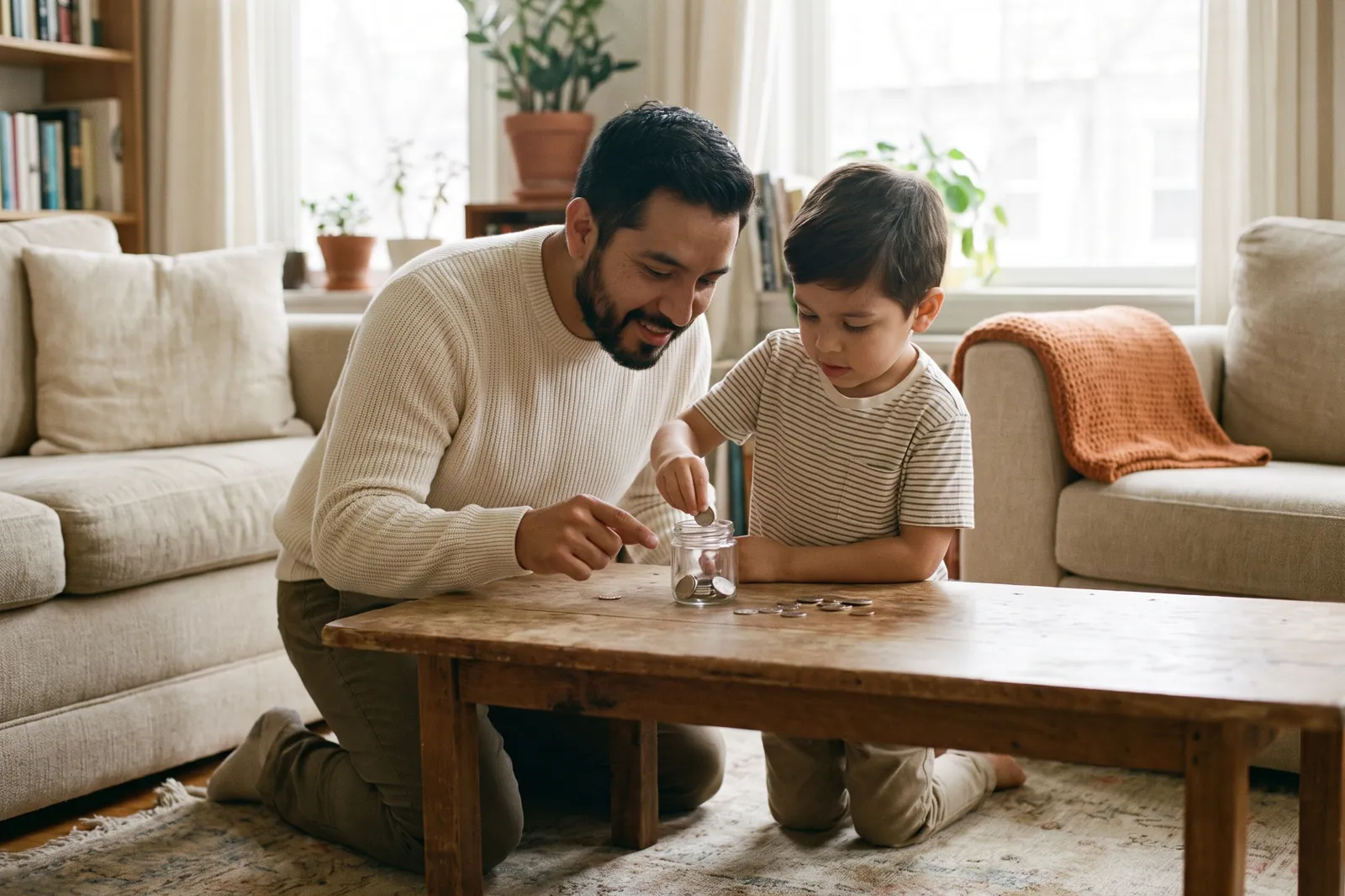
- Make it a family habit. “In our family, we save up for big things” is a group norm your child can join.
- Practice in small doses. Waiting is a skill, and skills grow with practice.
Delayed gratification activities for kids
- Grow something. Plant a bean or a carrot seed and check on it every day. The wait has a visible payoff.
- The two-later offer. “One sticker now, or two after lunch?” Then always deliver.
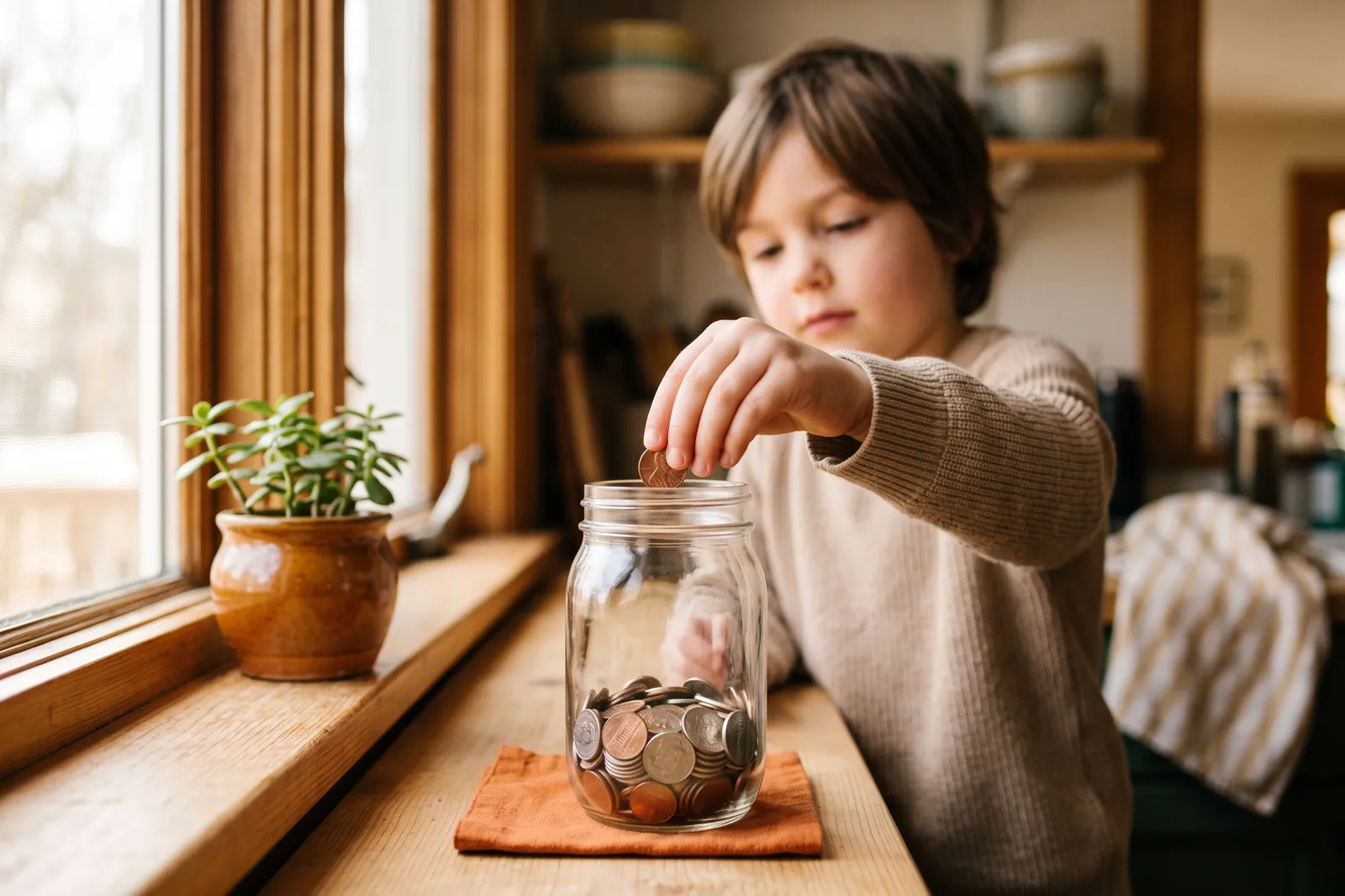
- Save for one thing. A clear jar, a picture of the goal and a short timeline turn waiting into money practice. See how to teach kids to save money.
- The wish list wait. When your child wants something at the store, write it down and look at the list again in a week. If they still want it, talk about saving for it.
- A small match for waiting. For ages 6 and up, the CFPB suggests a matching plan, such as adding 25 cents for every dollar saved. Waiting literally makes the pile bigger.
- Spend or save, out loud. When birthday money arrives, lay out both options: a small thing today, or a bigger thing in a few weeks. Let your child choose, and let them live with the choice.
For everyday waiting outside of money, like timers, turn-taking and stop-and-go games, see our guide on how to teach kids patience.
If a story helps, two titles from our list of books about patience for kids pair well with a seed on the windowsill: The Carrot Seed by Ruth Krauss, illustrated by Crockett Johnson, and Waiting by Kevin Henkes, a Caldecott Honor book.
If your child is three and cannot wait ten seconds, that is normal. Waiting grows a great deal between 3 and 8, and every small, kept promise helps. For the money side of the story, start with how to teach kids about money.
Questions parents ask
What is an example of delayed gratification for kids?
Saving birthday money for a bigger toy instead of spending it on candy today, waiting for a turn on the swing, or waiting until after dinner for dessert. Each one means giving up something now for something better later.
Does the marshmallow test predict success?
Much less than its reputation suggests. A 2018 replication with a larger, more diverse group of children found the link to achievement at 15 was about half the size originally reported, and it shrank by two thirds after accounting for family background, early cognitive ability and the home environment.
At what age can kids delay gratification?
The ability starts to show in the preschool years and grows a lot between about 3 and 8. In the 2018 replication, most of the difference in later achievement came from whether four-year-olds could wait at least 20 seconds, which suggests that even a short wait is a meaningful early step.
How can I teach my child delayed gratification?
Keep your promises about later, so waiting feels worth it. Teach simple strategies like putting the treat out of sight or playing a game while you wait. Practice with short, real goals such as saving for a small toy, and make waiting a family habit.
Sources
- Revisiting the Marshmallow Test: A Conceptual Replication Investigating Links Between Early Delay of Gratification and Later Outcomes (2018), Tyler W. Watts, Greg J. Duncan and Haonan Quan, Psychological Science
- Delay of gratification in children (1989), Walter Mischel, Yuichi Shoda and Monica Rodriguez, Science
- Cognitive and attentional mechanisms in delay of gratification (1972), Walter Mischel, Ebbe B. Ebbesen and Antonette R. Zeiss, Journal of Personality and Social Psychology
- Rational snacking: Young children's decision-making on the marshmallow task is moderated by beliefs about environmental reliability (2013), Celeste Kidd, Holly Palmeri and Richard N. Aslin, Cognition
- Group Influences on Engaging Self-Control (2018), Sabine Doebel and Yuko Munakata, Psychological Science
- Cohort effects in children's delay of gratification (2018), Stephanie M. Carlson and colleagues, Developmental Psychology
- Young children and saving
- School-age children and saving
Written by the WonderLab Journal editorial desk and checked against the sources above. Found something out of date? Tell us through the corrections page.